

Kaziranga National Park is not simply another tourist destination in Assam. It is a UNESCO World Heritage Site, one of India’s most important wildlife landscapes, and a globally significant stronghold of the greater one-horned rhinoceros. But the landscape surrounding Kaziranga is increasingly becoming the centre of a difficult question: how much development can take place around an ecologically sensitive protected area before development begins to undermine the very landscape attracting investment in the first place?
That debate has intensified around proposed luxury hospitality projects near Kaziranga and opposition from local communities and activists.
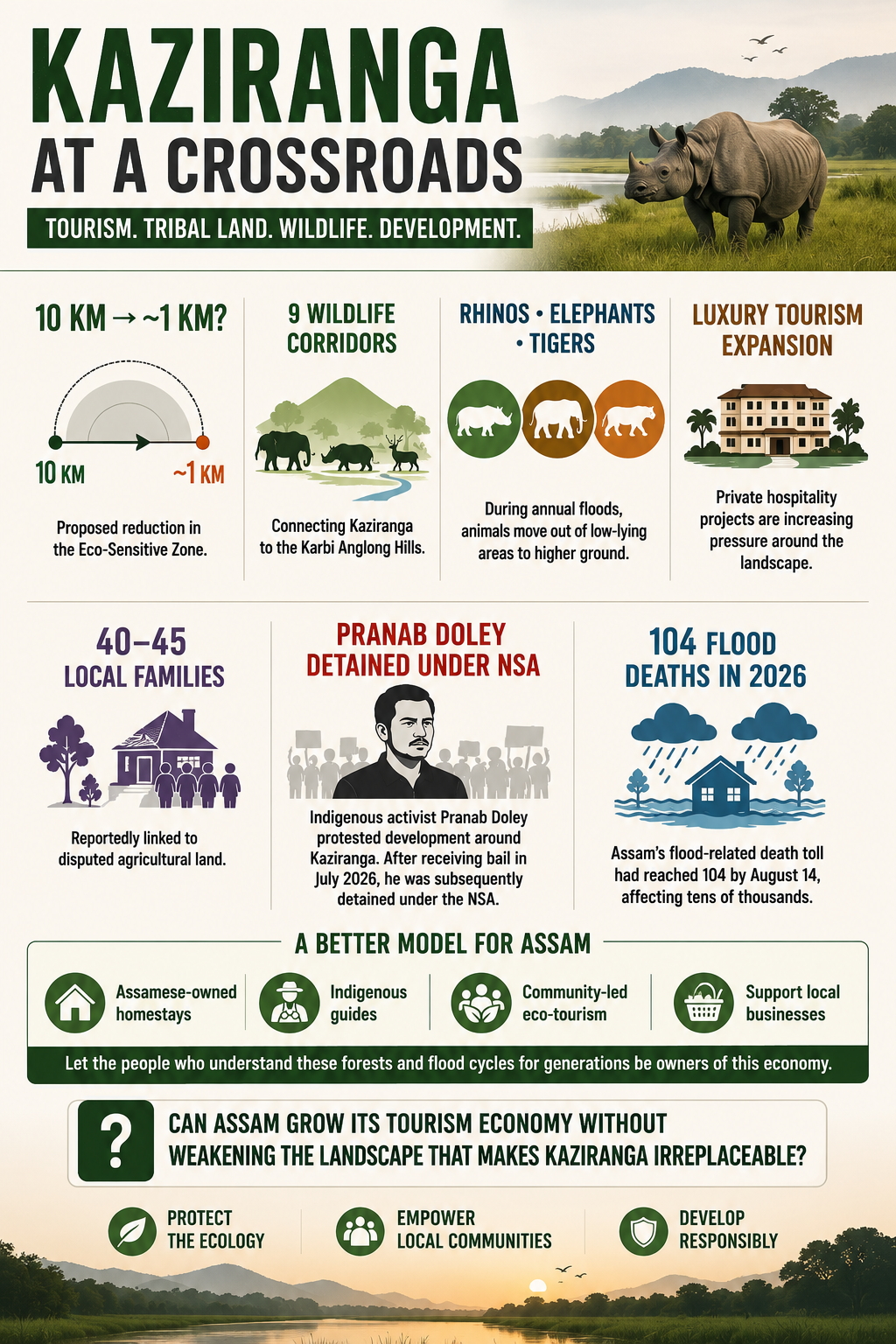
The controversy around Pranab Doley
Indigenous activist Pranab Doley has been associated with protests concerning land, community rights and tourism-related development around Kaziranga. His detention subsequently attracted wider attention because authorities invoked India’s National Security Act (NSA) against him.
The NSA is an extraordinary preventive-detention law. It can permit detention for extended periods without the ordinary criminal-trial process that would normally follow an arrest. Its use against an activist involved in land and environmental protests therefore raises a question extending beyond one individual: when communities oppose major development projects, where is the line between maintaining public order and suppressing legitimate democratic dissent?
This distinction matters. Arrest under a criminal allegation does not establish guilt, just as opposition to a development project does not automatically establish that the project is unlawful. But the use of preventive-detention powers against activists deserves particularly close public scrutiny.
Why Kaziranga cannot be viewed in isolation
Kaziranga’s ecological importance extends far beyond the administrative boundary of the national park.
The park sits within a much larger landscape connecting the floodplains of the Brahmaputra with the Karbi Anglong hills to the south. Wildlife moves across this landscape, particularly during the annual monsoon when large parts of Kaziranga become inundated.
Rhinos, elephants, tigers, deer and other animals move toward higher ground, making the corridors between Kaziranga and Karbi Anglong critically important.
A line drawn around a national park on a map therefore does not represent the actual boundary of its ecosystem.
Protecting Kaziranga while heavily developing the surrounding corridors would be comparable to protecting someone’s house while blocking every entrance and exit.
Roads, boundary walls, lighting, traffic, construction activity and intensive tourism infrastructure can all affect wildlife movement. The relevant question should consequently not be merely:
“Is the hotel outside the national park?”
It should also be:
“What ecological function does this land perform within the wider Kaziranga landscape?”
Wildlife corridors are infrastructure
Wildlife corridors are sometimes treated as empty spaces between protected forests. Ecologically, they are anything but empty.
They allow populations to move between habitats, reach seasonal feeding and breeding grounds, escape floods and other disturbances, and maintain genetic connectivity.
Around Kaziranga, this function becomes especially important because flooding is part of the ecosystem itself. Animals have historically responded to rising water by moving toward higher areas, including the Karbi Anglong landscape.
Development that constricts these routes can therefore create consequences far beyond the footprint of a single building.
And this is why arguments about hotels, resorts and commercial development around Kaziranga should not be reduced to the environmental footprint of an individual property.
The larger issue is cumulative development.
One resort may appear manageable.
Five resorts, additional roads, parking areas, walls, restaurants, lighting and supporting commercial infrastructure can fundamentally alter a landscape.
Environmental assessment therefore needs to ask not simply what one project will do, but what happens when many individually approved projects occupy the same ecological corridor over time.
The people living around Kaziranga matter too
There is another part of this discussion that receives considerably less attention.
The landscape around Kaziranga is not an untouched wilderness without human history.
Indigenous, tribal and other local communities have lived around these forests, agricultural lands and river systems for generations. Their livelihoods and knowledge are closely connected to seasonal flooding, agriculture, forests and wildlife.
When land used by these communities is proposed for tourism or commercial development, the debate cannot be limited to investment figures and hotel capacity.
Questions must also be asked about land rights, livelihoods, consent, compensation and who ultimately benefits from tourism development.
If families have cultivated land for generations, their relationship with that landscape cannot simply be measured through the commercial value of the property.
Development that generates tourism revenue while economically or physically displacing the communities already living within the landscape creates a fundamental contradiction.
Tourism itself is not the enemy
Kaziranga needs tourism.
Tourism generates employment, supports businesses, introduces visitors to Assam’s extraordinary biodiversity and can provide economic incentives for conservation.
The real question is what kind of tourism Assam chooses to build.
There is an enormous difference between tourism that extracts value from a landscape and tourism that circulates value through the communities protecting that landscape.
Instead of concentrating development primarily around large external hospitality projects, Assam has an opportunity to build a tourism economy around locally owned homestays, community lodges, Indigenous guides, wildlife interpretation, local food, handicrafts, cultural experiences and small-scale ecological tourism.
Imagine if a greater share of every rupee spent by a visitor to Kaziranga remained within the surrounding villages.
Local families could operate accommodation.
Young people could be trained as naturalists and guides.
Women-led enterprises could supply food, textiles and handicrafts.
Farmers could participate in agricultural tourism.
Communities possessing generations of ecological knowledge could become partners in conservation rather than obstacles to development.
That model does not mean rejecting private investment. It means ensuring that investment strengthens rather than displaces the existing ecological and social economy.
Local knowledge is an economic asset
People who have lived alongside Kaziranga for generations possess something that cannot easily be imported: place-based knowledge.
They understand when the river rises.
They know where animals move during floods.
They recognise seasonal changes in vegetation.
They understand agricultural cycles and patterns of human-wildlife interaction.
That knowledge has economic value in a tourism industry increasingly driven by travellers looking for authentic ecological and cultural experiences.
Instead of replacing that knowledge with standardized tourism infrastructure, Assam could build an internationally recognised model of community-based conservation tourism around it.
The communities living beside Kaziranga should not merely provide low-wage labour for tourism.
They should have the opportunity to own part of the tourism economy.
Forests are infrastructure, not decoration
The development debate also needs to recognise a larger truth about Assam.
Forests, wetlands, floodplains and hills are not undeveloped spaces waiting to become economically useful.
They are already performing economically valuable functions.
They store carbon.
They regulate water.
They stabilize soil.
They provide habitat.
They reduce erosion.
They support agriculture and fisheries.
And in a state repeatedly exposed to extreme rainfall, erosion and flooding, healthy ecosystems form part of Assam’s natural protective infrastructure.
This does not mean that every flood can be blamed on deforestation or that conserving forests will eliminate flooding. Assam’s flood dynamics are complex and are strongly influenced by monsoon rainfall, the Brahmaputra river system, sedimentation, erosion and geography.
But destroying forests, wetlands and natural drainage systems can make vulnerable landscapes less resilient.
For precisely this reason, dramatic statistics about forest loss or flood deaths should not be used casually. Claims such as “14% of global forest loss,” “3,400 square kilometres destroyed,” “174 million tonnes of CO₂,” or “80 deaths caused by deforestation” require specific datasets, dates and causal evidence before being presented as fact. Weak statistics can undermine an otherwise powerful environmental argument.
The evidence-based case for protecting Kaziranga is already strong enough without exaggeration.
Development versus conservation is the wrong debate
Assam should not have to choose between economic development and environmental protection.
The better question is:
What form of development creates prosperity without destroying the ecological assets on which that prosperity depends?
Kaziranga itself demonstrates why this matters.
Its rhinoceroses, elephants, tigers, wetlands, grasslands, forests and dramatic annual flood cycle have created something extraordinarily valuable: a landscape recognised around the world.
That natural capital cannot simply be reconstructed somewhere else.
A hotel can be built elsewhere.
A road can be rerouted.
Tourism infrastructure can be redesigned.
But once an important wildlife corridor is fragmented, a wetland filled, a forest cleared or a traditional community displaced, reversing that decision can be extraordinarily difficult.
There is another path
Assam has an opportunity to demonstrate that conservation and economic development do not have to be enemies.
Luxury tourism can exist where ecological assessments establish that it is appropriate.
Infrastructure can be developed without blocking essential wildlife movement.
Tourism revenue can fund conservation.
Local and Indigenous communities can become owners, entrepreneurs and decision-makers within the tourism economy.
And major development proposals around Kaziranga can be assessed not only according to their individual footprints but according to their cumulative impact on the entire Kaziranga–Karbi Anglong landscape.
That would represent development in the fullest sense of the word.
Because Assam’s forests, rivers, wildlife and Indigenous communities are not obstacles standing in the way of its future.
They are part of what makes that future valuable.
And if development destroys the very landscape that makes Kaziranga extraordinary, Assam will not simply have lost trees or wildlife habitat.
It will have exchanged something irreplaceable for something that could have been built almost anywhere.
Important links
- Assam Forest Department – Nine Animal Corridors
- Gauhati High Court – Kaziranga ESZ Case
- National Green Tribunal – Kaziranga Hotel Case
- Juniper Hotels – Alila by Hyatt Kaziranga Project
- ThePrint – Pranab Doley NSA Detention
- MHA – National Security Act, 1980
- Mongabay – Luxury Hotels Around Kaziranga
- EastMojo – Local Families & Kaziranga Land Dispute
- Times of India – Kaziranga ESZ 10 km to 1 km Proposal