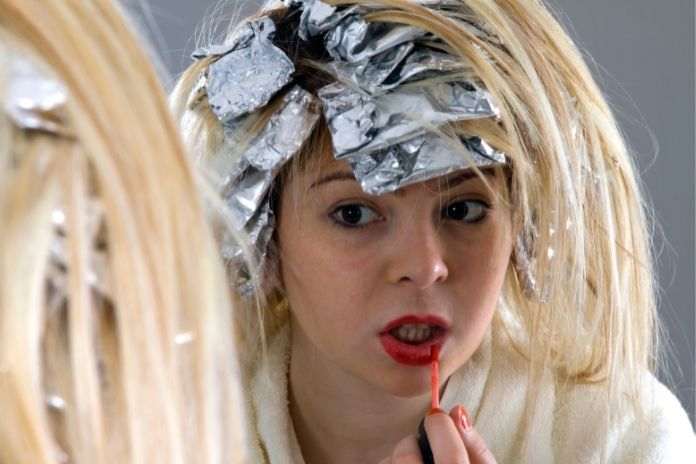
Damaged hair is usually fixable. Not always immediately, but almost always within 8–12 weeks if you stop the bad habits and start the right ones. The problem is most “hair repair” advice online is either expensive products (most don’t deliver) or oversimplified one-liners (“just trim it!”). Neither helps.
This post is the real stylist playbook. 23 hair care tips for damaged hair sorted by timeline — quick wins you can do tonight (immediate softness), weekly habits that compound (visible difference in 4 weeks), and the long-term repair routine (the changes that actually heal the damage).
You’ll also get the what NOT to do list. Most damaged hair gets worse because people are doing one or two destructive things they don’t realize are destructive. Stop those first; the rest works faster.
What “Damaged Hair” Actually Means
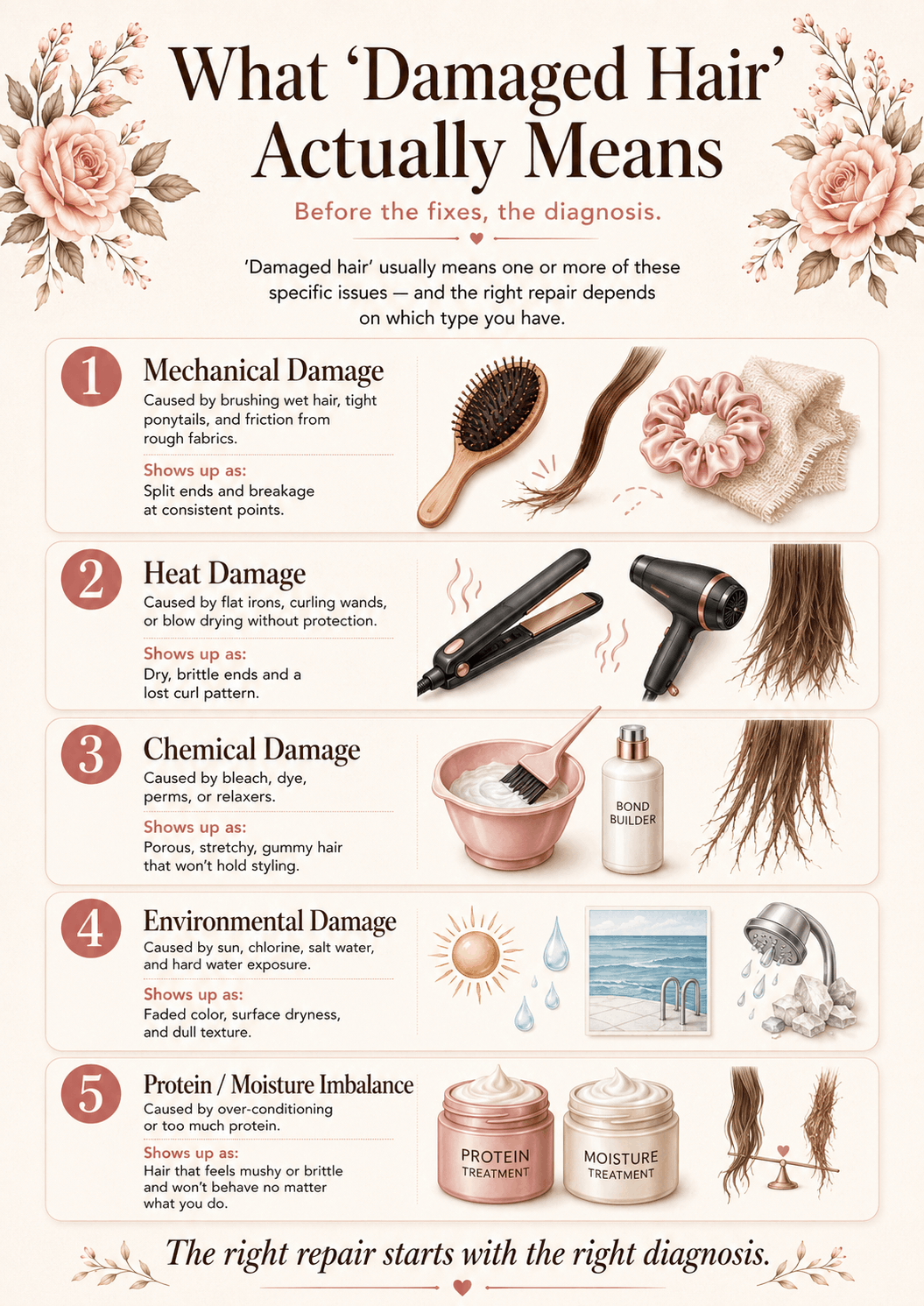
Before the fixes, the diagnosis. “Damaged hair” usually means one or more of these specific things — and the right repair depends on which type you have.
Mechanical damage. From brushing wet hair, tight ponytails, friction with rough fabric. Shows up as split ends and breakage at consistent points.
Heat damage. From flat irons, curling wands, blow drying without protection. Shows up as dry, brittle ends and lost curl pattern.
Chemical damage. From bleach, dye, perms, relaxers. Shows up as porous, stretchy, gummy hair that doesn’t hold styling.
Environmental damage. From sun, chlorine, salt water, hard water. Shows up as faded color, surface dryness, and dull texture.
Protein/moisture imbalance. From over-conditioning (mushy hair) or over-proteining (brittle hair). Shows up as hair that won’t behave no matter what you do.
Tonight Quick Wins
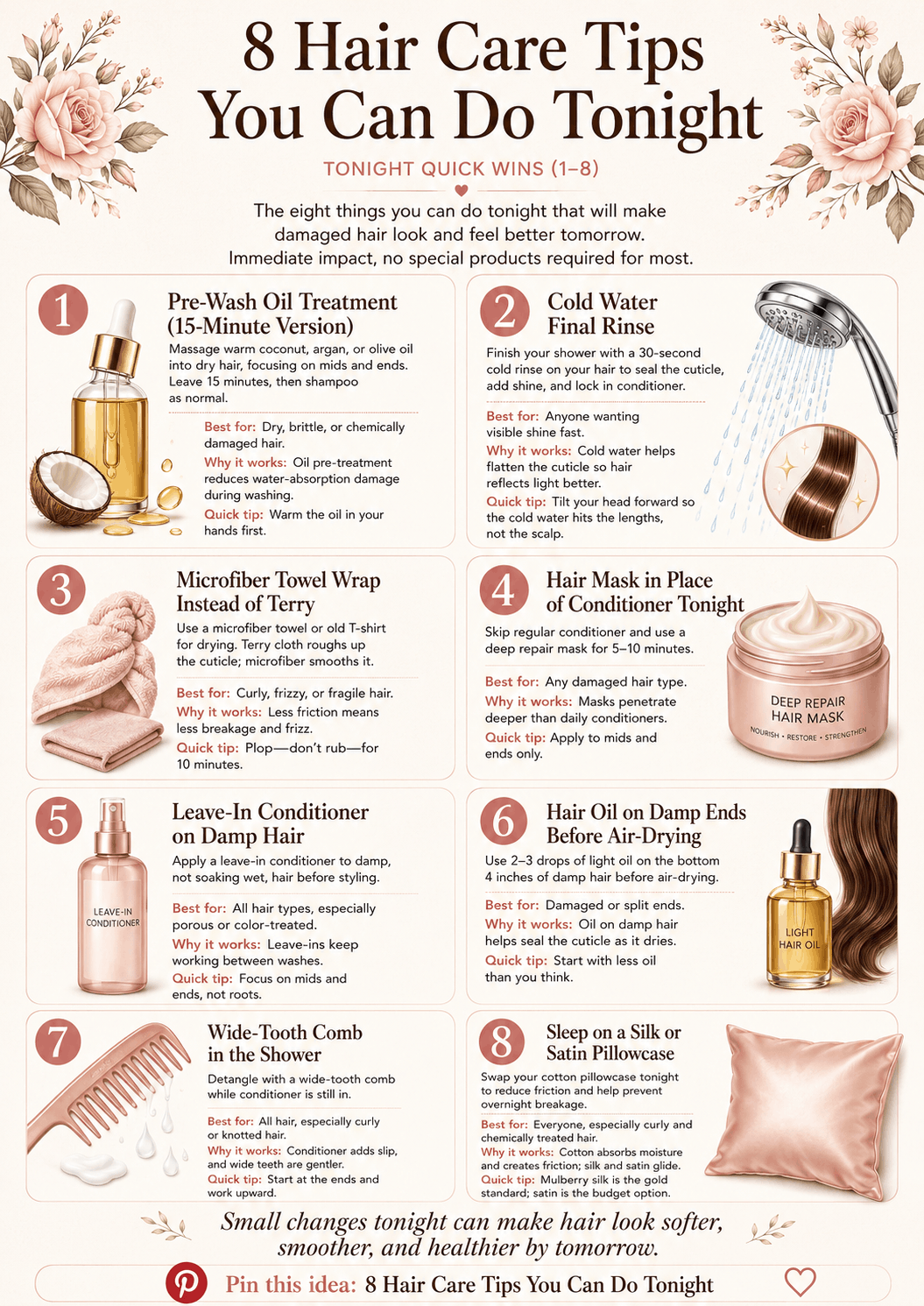
The eight things you can do tonight that will make damaged hair look and feel better tomorrow. Immediate impact, no special products required for most.
1. Pre-Wash Oil Treatment (15-Minute Version)
Massage warm coconut, argan, or olive oil into dry hair (focus on mids and ends), leave for 15 minutes, then shampoo as normal. Immediately softer hair.
Best for: Dry, brittle, or chemically damaged hair.
Why it works: Oil pre-treatment reduces water absorption damage during washing.
Quick tip: Warm the oil 10 seconds in your hands first — cold oil doesn’t penetrate.
2. Cold Water Final Rinse
Finish your shower with a 30-second cold water rinse on your hair. Seals the cuticle, adds instant shine, locks in conditioner.
Best for: Anyone wanting visible shine in one wash.
Why it works: Cold water flattens the cuticle, making hair reflect light better.
Quick tip: Tilt your head forward so cold water hits the lengths, not your scalp.
3. Microfiber Towel Wrap Instead of Terry
Replace your regular cotton towel with a microfiber towel or old t-shirt for drying. Terry cloth roughs up the cuticle; microfiber smooths it.
Best for: Anyone with curly, frizzy, or fragile hair.
Why it works: Less friction = less breakage and less frizz.
Quick tip: Plop (don’t rub) for 10 minutes to remove excess water without damage.
4. Hair Mask in Place of Conditioner Tonight
Skip your regular conditioner and use a deep repair mask for 5–10 minutes. Even a one-time mask treatment shows visible improvement.
Best for: Any damaged hair type, immediate softness.
Why it works: Masks penetrate deeper than daily conditioners.
Quick tip: Apply to mids and ends only — masks on the scalp cause flat oily roots.
5. Leave-In Conditioner on Damp Hair
Spray or apply a leave-in conditioner to damp (not soaking wet) hair before any styling. Provides ongoing moisture protection.
Best for: All hair types, especially porous or color-treated.
Why it works: Leave-ins keep working between washes.
Quick tip: Focus on mids and ends — leave-ins on roots cause greasy roots.
6. Hair Oil on Damp Ends Before Air-Drying
Apply 2–3 drops of light hair oil (argan, marula, or rosehip) on the bottom 4 inches of damp hair before air-drying. Soft, shiny ends with no styling.
Best for: Anyone with damaged or split ends.
Why it works: Oil on damp hair seals the cuticle as it dries.
Quick tip: Always start with less oil than you think — too much weighs down hair.
7. Wide-Tooth Comb in the Shower (Conditioner Still In)
Detangle hair in the shower with a wide-tooth comb while conditioner is still in. Less breakage than detangling dry or post-shower.
Best for: All hair, especially curly or knotted hair.
Why it works: Conditioner provides slip; wide teeth don’t snap hair.
Quick tip: Start at the ends and work up, never top-down.
8. Sleep on a Silk or Satin Pillowcase
Replace your cotton pillowcase tonight. Reduces hair friction by 80%, prevents overnight breakage, keeps blowouts intact.
Best for: Everyone, especially curly and chemically treated hair.
Why it works: Cotton absorbs moisture and creates friction; silk/satin slides.
Quick tip: Mulberry silk is the gold standard; satin is the affordable substitute.
Weekly Habits That Compound
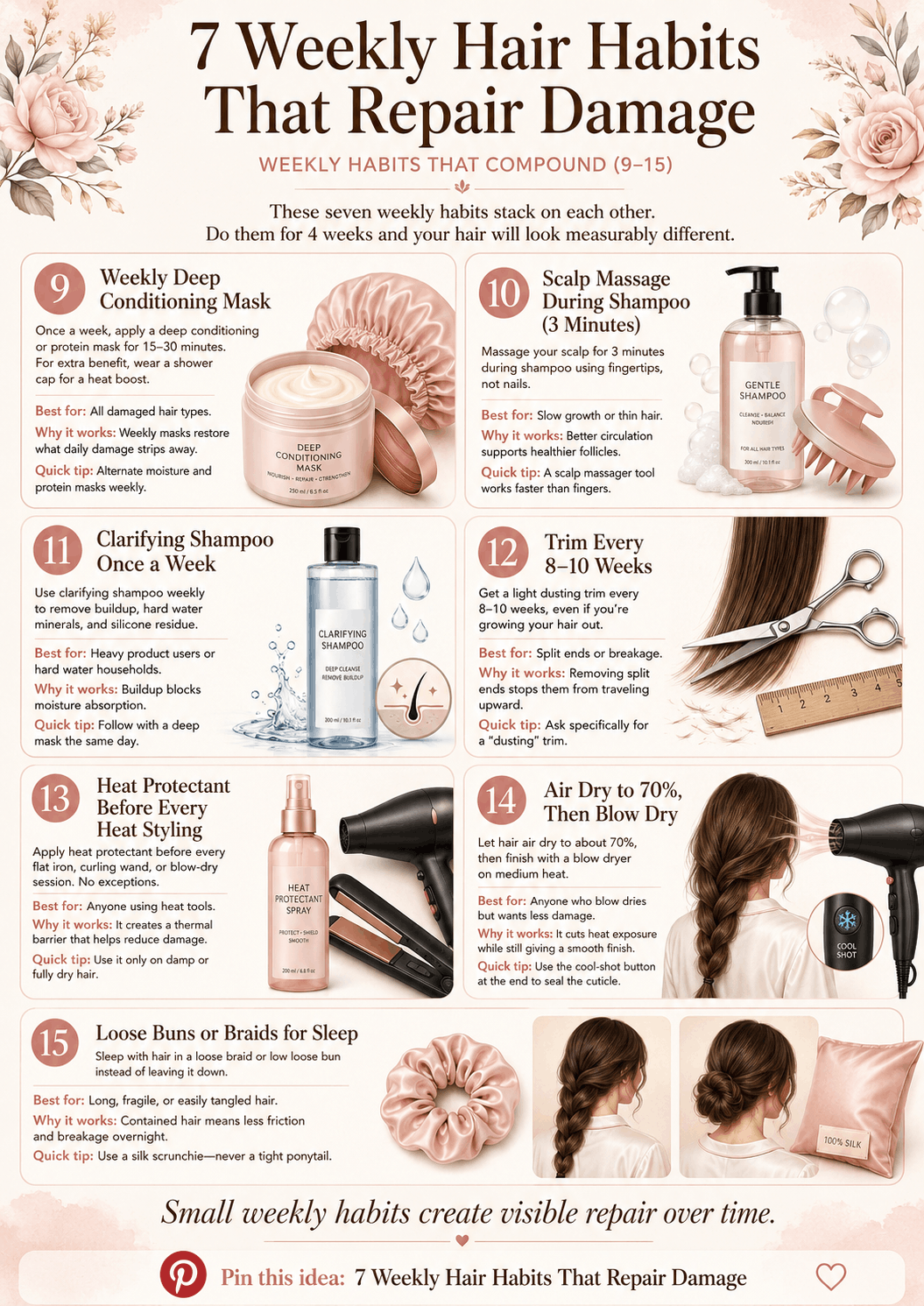
These seven weekly habits stack on each other. Do them for 4 weeks and your hair will look measurably different.
9. Weekly Deep Conditioning Mask
Once a week, apply a deep conditioning or protein mask for 15–30 minutes (under a shower cap for heat boost). Non-negotiable for damaged hair.
Best for: All damaged hair types.
Why it works: Weekly masks restore what daily damage strips.
Quick tip: Alternate moisture mask and protein mask weekly — balance is everything.
10. Scalp Massage During Shampoo (3 Minutes)
Massage your scalp for 3 minutes during shampoo, using fingertips (not nails). Improves circulation and stimulates growth.
Best for: Anyone with slow growth or thin hair.
Why it works: Increased blood flow = healthier follicles.
Quick tip: A scalp massager tool ($10) does this better and faster than fingers.
11. Clarifying Shampoo Once a Week
Use a clarifying shampoo once a week to remove product buildup, hard water minerals, and silicone residue. Resets hair to receive moisture.
Best for: Anyone using lots of styling products or hard water households.
Why it works: Buildup blocks moisture absorption — clarifying removes the barrier.
Quick tip: Always follow clarifying shampoo with a deep mask the same day.
12. Trim Every 8–10 Weeks (Even If Growing Out)
Schedule a “dusting” — a 1/4 to 1/2 inch trim — every 8–10 weeks, even if you’re growing your hair out. Removes split ends before they travel up the shaft.
Best for: Anyone with split ends or breakage.
Why it works: Split ends keep splitting upward until trimmed — letting them go means losing length, not saving it.
Quick tip: Ask for “dusting” specifically — stylists default to inch+ cuts otherwise.
13. Heat Protectant Before Every Heat Styling
Apply heat protectant spray or cream before EVERY heat tool, every time. No exceptions. Even on the 1-minute touch-up.
Best for: Anyone using flat irons, curling wands, or blow dryers.
Why it works: Heat protectant creates a thermal barrier that reduces damage by 50%+.
Quick tip: Heat protectant only works on damp or fully dry hair, not in between.
14. Air Dry to 70%, Then Blow Dry the Rest
Let hair air dry to about 70% dry, then finish with a blow dryer on medium heat. Cuts heat exposure in half while still getting the smooth blow-dry finish.
Best for: Anyone who blow dries but wants less damage.
Why it works: Soaking wet hair takes the longest heat exposure to dry.
Quick tip: Use the cool shot button at the end to seal the cuticle.
15. Loose Buns/Braids for Sleep (Not Down)
Put hair in a loose braid or low loose bun before sleeping. Prevents the tangling and friction that happens with hair worn down overnight.
Best for: Long hair, fragile hair, restless sleepers.
Why it works: Contained hair = less breakage from pillow friction.
Quick tip: Use a silk scrunchie (not elastic) to avoid the dent — and never a tight ponytail.
Long-Term Repair Routine (16–23)
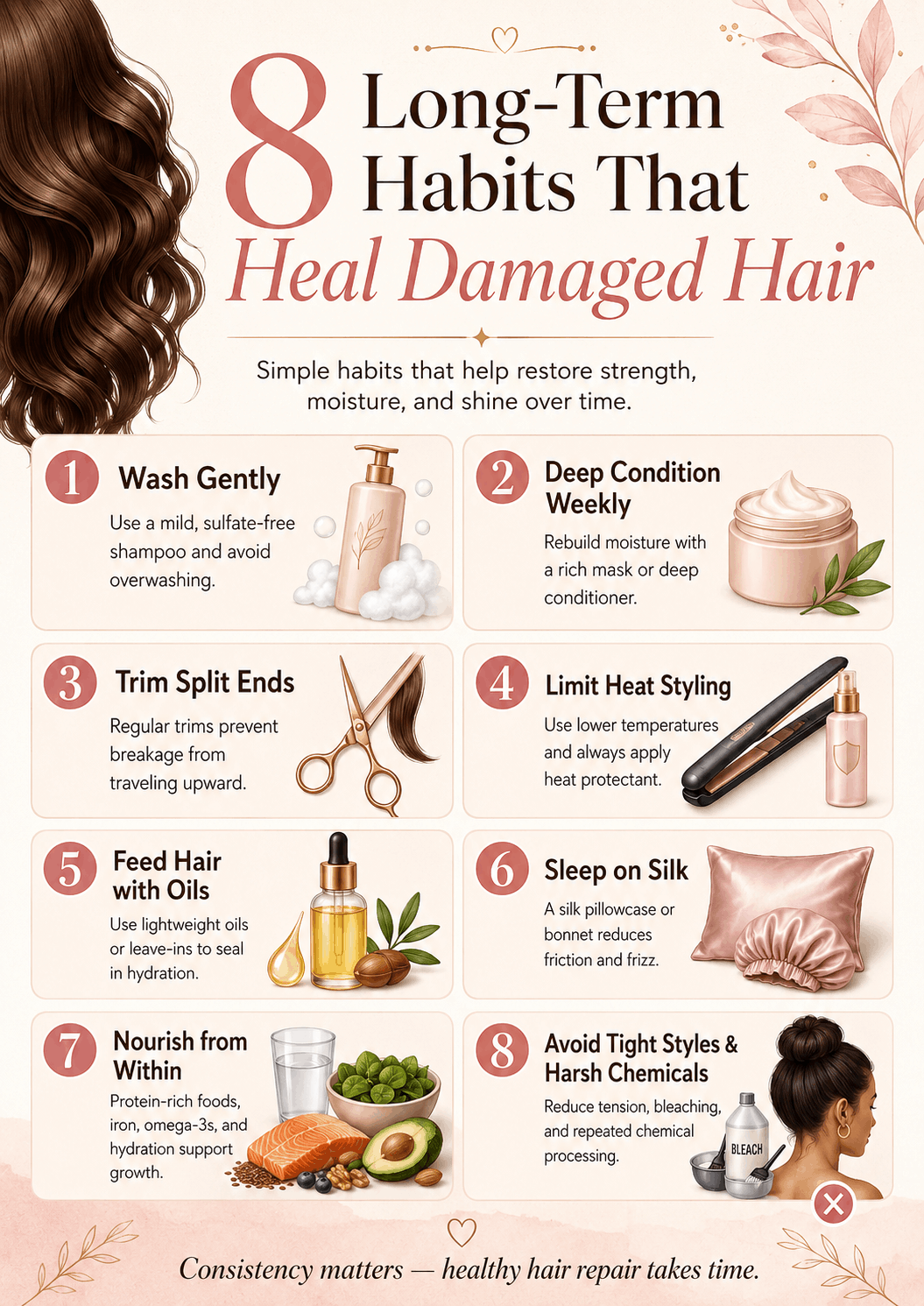
The eight changes that actually heal damaged hair over 8–12 weeks. These are the foundational shifts, not the surface fixes.
16. Bond Repair Treatment Every 2 Weeks
A bond repair treatment (Olaplex No. 3, K18, or similar) used every 2 weeks rebuilds broken disulfide bonds in the hair. The single most effective damage repair product class.
Best for: Chemically damaged or over-processed hair.
Why it works: Bond repair actually reconnects broken hair bonds (rare for any product).
Quick tip: K18 is faster (4 minutes); Olaplex No. 3 needs 30+ minutes for effect.
17. Switch to Sulfate-Free Shampoo
Replace your regular shampoo with a sulfate-free version. Sulfates strip oils aggressively; sulfate-free cleans without stripping.
Best for: All damaged hair, color-treated hair, dry hair.
Why it works: Sulfates remove natural oils your damaged hair needs.
Quick tip: Sulfate-free shampoos lather less — that’s normal, not under-cleaning.
18. Reduce Wash Frequency to 2–3x Per Week
If you wash daily, reduce to every other day. If every other day, reduce to twice a week. Hair recovers faster with less washing.
Best for: Anyone with naturally dry or damaged hair.
Why it works: Each wash strips some oil; less washing = more natural moisture.
Quick tip: Dry shampoo handles roots between washes — apply at night for next-morning absorption.
19. Take Hair-Specific Supplements (Biotin + Iron + Vitamin D)
Daily supplementation with biotin, iron, and vitamin D supports hair growth from the inside. Most damaged hair correlates with one or more deficiencies.
Best for: Slow growth, shedding, thin hair.
Why it works: Hair is made from what you eat — supplementation supports new growth.
Quick tip: Get blood work done before mega-dosing biotin — too much can cause acne.
20. Increase Protein in Your Diet
Hair is 95% keratin (a protein). Insufficient dietary protein = slow growth and weak strands. Aim for 0.36g per pound of body weight minimum.
Best for: Anyone whose diet is low in animal or plant proteins.
Why it works: Without raw materials, hair can’t repair or grow.
Quick tip: A daily protein shake is the easiest add-in for most people.
21. Install a Shower Filter for Hard Water
If you have hard water (mineral deposits on faucets), install a $30–$50 shower filter. Hard water damages hair more than you’d guess.
Best for: Anyone with hard water (most U.S. cities).
Why it works: Removes calcium, chlorine, and minerals that coat hair and dull color.
Quick tip: Replace the filter cartridge every 6 months.
22. Eliminate One Heat Tool from Your Routine
Pick the heat tool you use most often and find an alternative. Air dry instead of blow dry, heatless curls instead of curling iron, or skip the flat iron for embracing your natural texture.
Best for: Anyone heat-styling daily.
Why it works: Heat damage is cumulative — one fewer tool dramatically reduces total exposure.
Quick tip: Heatless curls (overnight curlers, silk scrunchies, robe-tie technique) replicate curling iron results.
23. Consult a Trichologist if Damage Is Severe
If you’ve done everything above for 12 weeks and hair isn’t improving, see a trichologist (hair scalp specialist). Could be hormonal, medical, or something requiring professional diagnosis.
Best for: Severe shedding, sudden damage, unexplained thinning.
Why it works: Some hair damage is medical — products alone won’t fix it.
Quick tip: Bring photos and a list of products you use to your appointment.
What NOT to Do (The Damage Multipliers)
These five habits double or triple the damage repair time. Stop these first; the rest of the routine works faster.
Don’t brush wet hair with a regular brush. Wet hair stretches; regular brush teeth snap it. Use a wide-tooth comb or a wet brush specifically.
Don’t use flat irons above 350°F. Higher temperatures don’t straighten faster, just damage faster. 350°F is the threshold for most hair types.
Don’t tie hair tight when wet. Wet hair tied tightly = traction breakage at the band line. Wait until at least 70% dry to put hair up.
Don’t skip protein OR overdo protein. Imbalanced hair (too much or too little protein) breaks more. Alternate protein and moisture treatments weekly.
Don’t bleach over already-damaged hair. Always do bond protector treatments BEFORE bleaching. Bleaching damaged hair is the #1 cause of hair “breaking off in chunks.”
For more on damage diagnostics and product chemistry, Allure’s hair health coverage has excellent stylist-vetted breakdowns of what actually works.
Products Worth Buying (Stylist Picks)
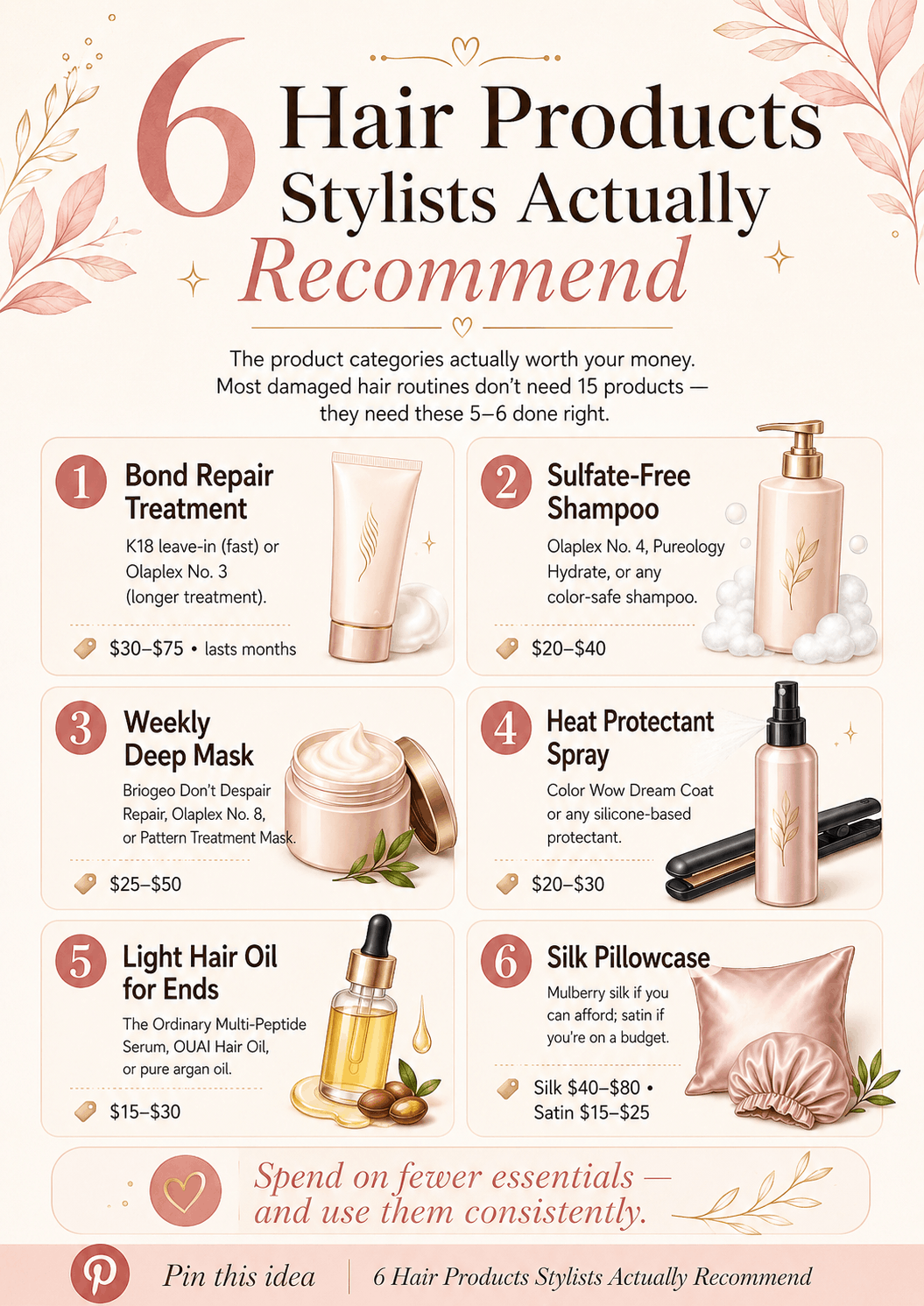
The product categories actually worth your money. Most damaged hair routines don’t need 15 products — they need these 5–6 done right.
Bond repair treatment. K18 leave-in (fast) or Olaplex No. 3 (longer treatment). $30–$75 but lasts months.
Sulfate-free shampoo. Olaplex No. 4, Pureology Hydrate, or any “color-safe” shampoo. $20–$40.
Weekly deep mask. Briogeo Don’t Despair Repair, Olaplex No. 8, or Pattern Treatment Mask. $25–$50.
Heat protectant spray. Color Wow Dream Coat or any silicone-based protectant. $20–$30.
Light hair oil for ends. The Ordinary Multi-Peptide Serum, OUAI Hair Oil, or pure argan oil. $15–$30.
Silk pillowcase. Mulberry silk if you can afford ($40–$80); satin if budget ($15–$25).
FAQs
How long does it take to repair damaged hair?
Surface improvements: 1–2 weeks (softness, shine). Visible structural improvement: 4–8 weeks (less breakage, better texture). Full repair: 8–12 weeks for moderate damage, 4–6 months for severe damage. Hair grows about 1/2 inch per month, so truly damaged ends need to be trimmed off — they can’t be “healed.”
What’s the single best product for damaged hair?
Bond repair treatments (K18 or Olaplex No. 3). They’re the only product category that actually rebuilds broken hair bonds rather than just coating the strand. If you can only afford one repair product, make it this one.
Can you actually repair split ends without cutting?
No — but you can temporarily fuse them with split-end serums or oils, which buys time between trims. Permanent repair of a split end is impossible; the hair structure is already broken. The realistic plan: trim every 8 weeks + use serums to manage the in-between.
How often should I wash damaged hair?
2–3 times per week is ideal for most damaged hair. Daily washing strips oils that damaged hair desperately needs. If you have oily roots, dry shampoo handles the in-between days. The exception: extremely curly/textured hair often washes only 1x per week.
Is it true that hair can’t be “repaired,” only “managed”?
Partly true. Once hair leaves your scalp, it’s technically dead — so “repair” is really about strengthening what’s there and preventing more damage. But bond repair treatments DO restore broken bonds in existing hair, which functionally is repair. The new growth (1/2 inch per month) is genuinely healthy. So: existing damaged hair gets strengthened and managed; new growth replaces the damage gradually.
Conclusion
Damaged hair is fixable, but it takes a strategy, not a product. The 23 tips above are the actual stylist playbook — quick wins for tonight to feel immediate progress, weekly habits to compound results, and long-term shifts that genuinely heal damage over 8–12 weeks.
Pick three tips to start tonight, three more to add this week, and three for the long-term plan. Don’t try all 23 at once — overhauling everything is how most people abandon repair routines in week 2.


![4 Best Locking Gel for Dreads [Ultimate Guide]](https://magicalassam.com/review/wp-content/uploads/2022/06/Best-Locking-Gel-for-Dreads.jpg)