If you’ve ever walked out of a salon and felt like your face looked wider than when you went in, it was almost certainly the haircut. The wrong layers — heavy bobs, blunt cuts that hit the cheekbone, layers that start too high — add visual width exactly where a round face doesn’t need it.
Long layered haircuts do the opposite. Length itself creates vertical lines that visually elongate the face. Strategically placed layers add movement and dimension without bulk, drawing the eye up and down rather than side to side. The right layered cut on a round face shape doesn’t hide the roundness — it balances it.
The 23 cuts below are sorted by style type so you can jump to the vibe you want. Every one of them works on a round face when cut correctly. The trick is in the details: where the shortest layer starts, how the face-framing pieces fall, and what you do with the front section.
Save the ones you love. Take three reference photos to your stylist. The rules section below tells you exactly what to ask for.
The 4 rules for layered haircuts on round faces
Before the gallery, these four principles separate a cut that flatters a round face from one that fights it:
Rule 1: Layers start below the chin, never above. This is the single most important rule. A face-framing layer that starts at the cheekbone or jawline adds width to the widest part of your face. Layers should start at the chin or lower — collarbone level is even safer. The goal is to draw the eye past the cheek, not stop attention at it.
Rule 2: Vertical lines over horizontal ones. A V-cut perimeter is more flattering than a blunt one. Side-swept layers are more flattering than blunt-across. Anything that creates a vertical line down the length of the hair visually slims the face.
Rule 3: Skip heavy, blunt-across bangs. Straight-across bangs that sit just above the eyebrows shorten the face vertically — exactly the opposite of what a round face needs. Curtain bangs, side-swept bangs, and long wispy fringe all work beautifully. Heavy “Bettie Page” bangs do not.
Rule 4: Add volume at the crown, not the cheekbones. Volume at the top of the head adds height, which elongates the face. Volume at the sides (think 1980s “wings”) adds width. When you style your layers, lift at the roots and smooth at the cheek line.
Now the styles.
Long layered cuts with curtain bangs
The single biggest haircut trend of 2026, and one of the most flattering options for round faces. Curtain bangs part naturally down the middle, framing the face vertically rather than horizontally.
1. Classic long layers with curtain bangs
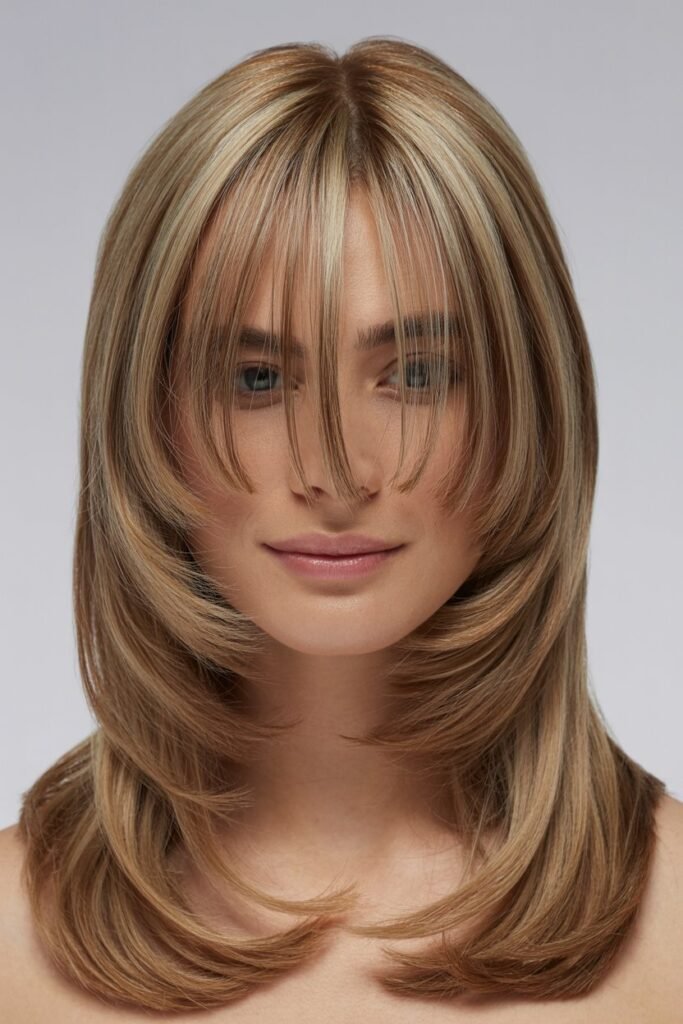
The reference cut. Long layers starting at the chin, curtain bangs that sweep from a center part down past the cheekbones, and length to the mid-back. The curtain bangs do most of the work — they create a vertical line down the center of the face that visually narrows the cheek area. Margot Robbie and Zendaya have both worn this exact combination on the red carpet.
2. Long layers with longer curtain bangs
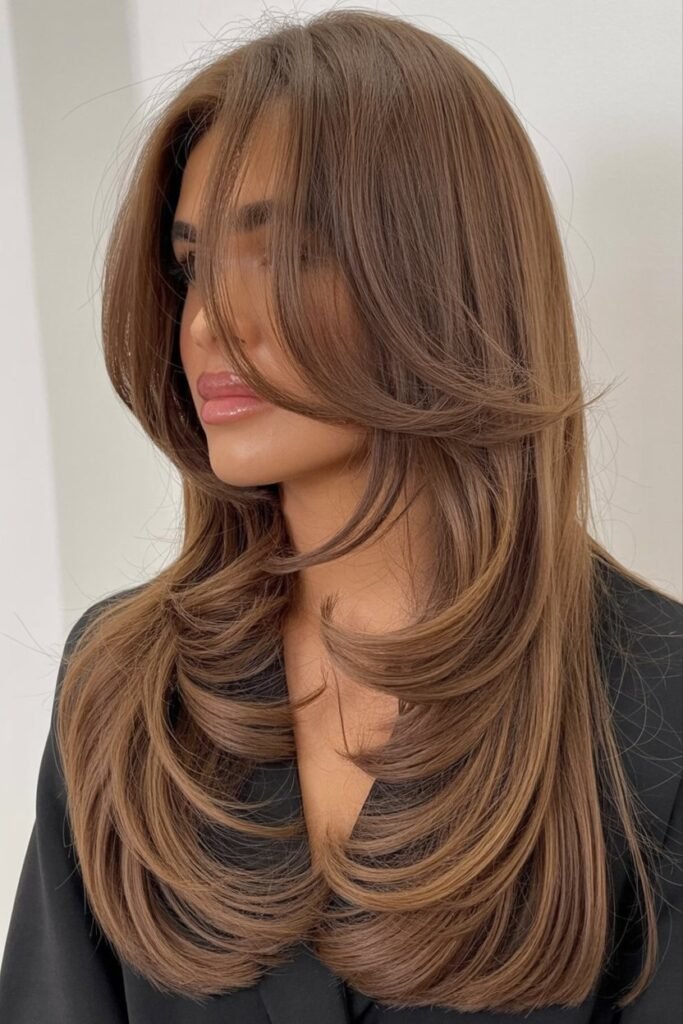
A variation where the curtain bangs extend almost to the collarbone instead of stopping at the cheekbone. Even more elongating than the classic version. Best for people with rounder faces who want maximum slimming effect from the front section.
3. Side-swept curtain bangs with long layers
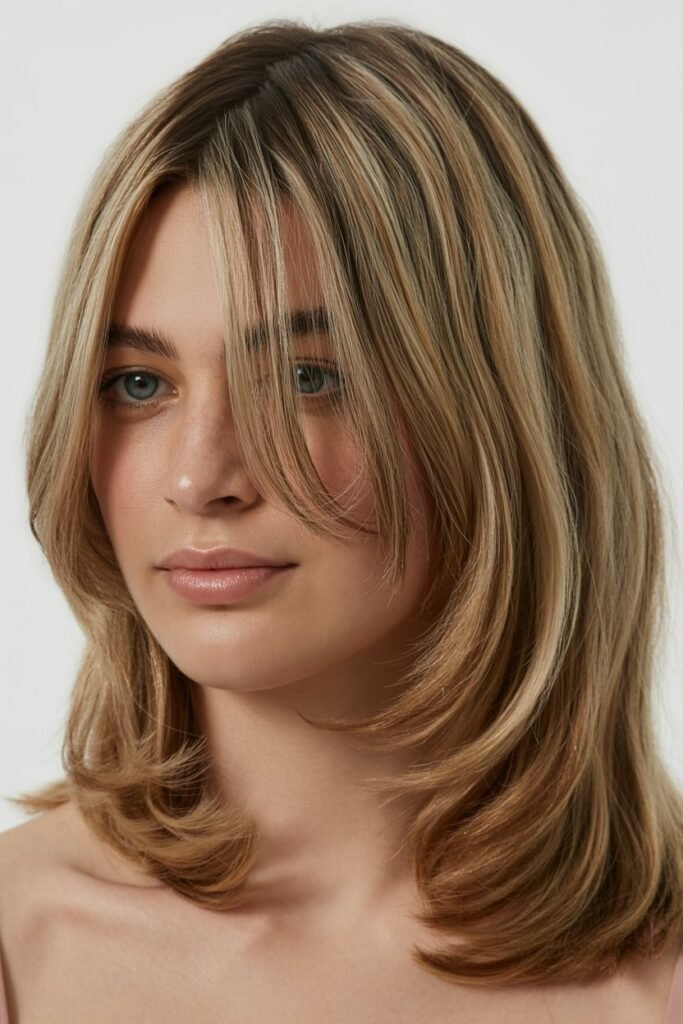
The curtain bangs are cut asymmetrically — slightly shorter on one side, swept across to the other. The diagonal line is hugely flattering on a round face because it creates angular definition where the face is softest.
4. Wispy curtain bangs with face-framing layers
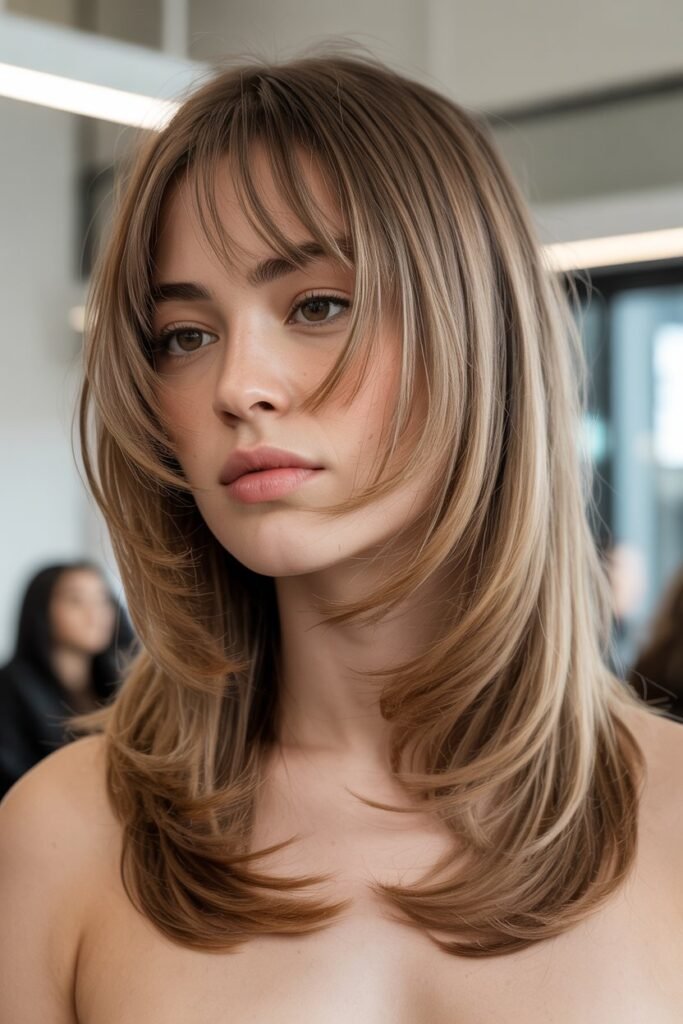
Lighter, more textured curtain bangs combined with face-framing layers that start at the chin. Romantic, soft, very 2026. Works especially well for thin or fine hair because the wispy texture creates the illusion of more density.
5. Curtain bangs with V-cut long layers
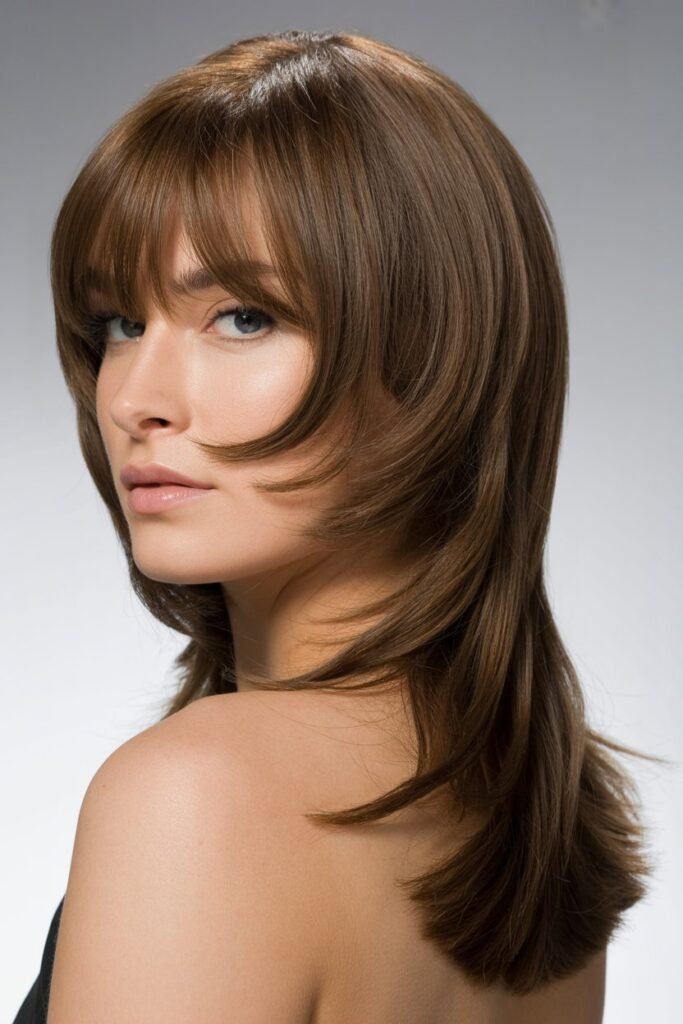
Curtain bangs at the front, V-cut perimeter at the back. The V-shape at the back creates a vertical visual line down the spine, which adds to the elongating effect of the bangs at the front. Sophisticated, modern.
6. Curtain bangs with long layers and money piece
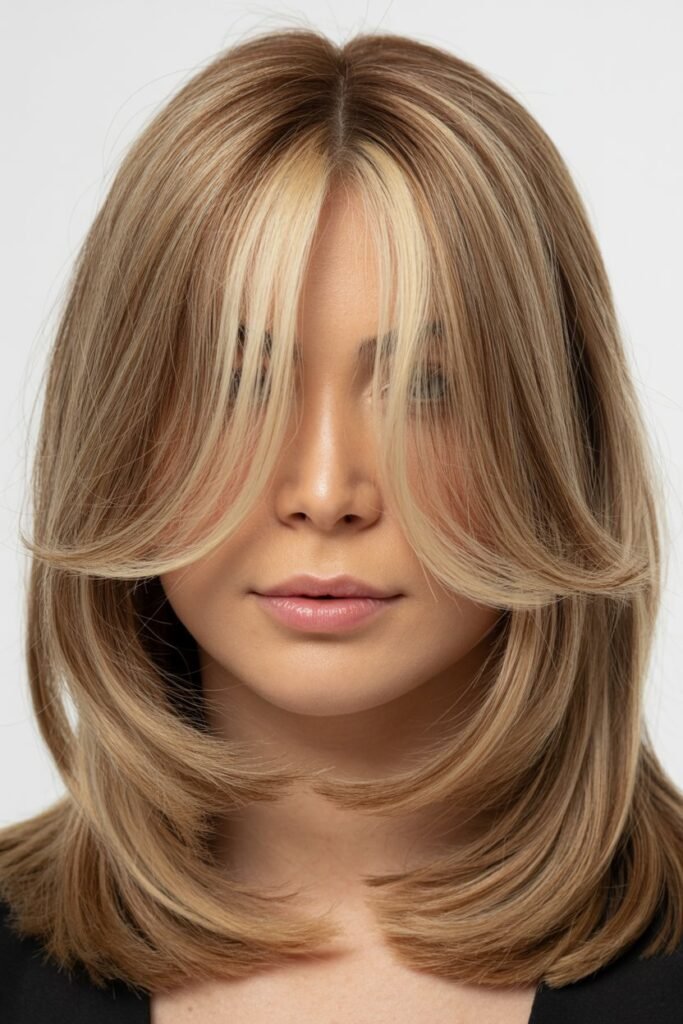
Curtain bangs frame the face, plus a “money piece” — two lighter-colored sections at the front of the curtain bangs. The lightness draws the eye to the center of the face rather than the cheek width. Foolproof on round faces.
Butterfly and shag cuts for round faces
The butterfly cut and “Bombshell Shag” are two of the biggest long haircut trends in 2026. Both work beautifully on round faces when cut with the right proportions.
7. Long butterfly cut
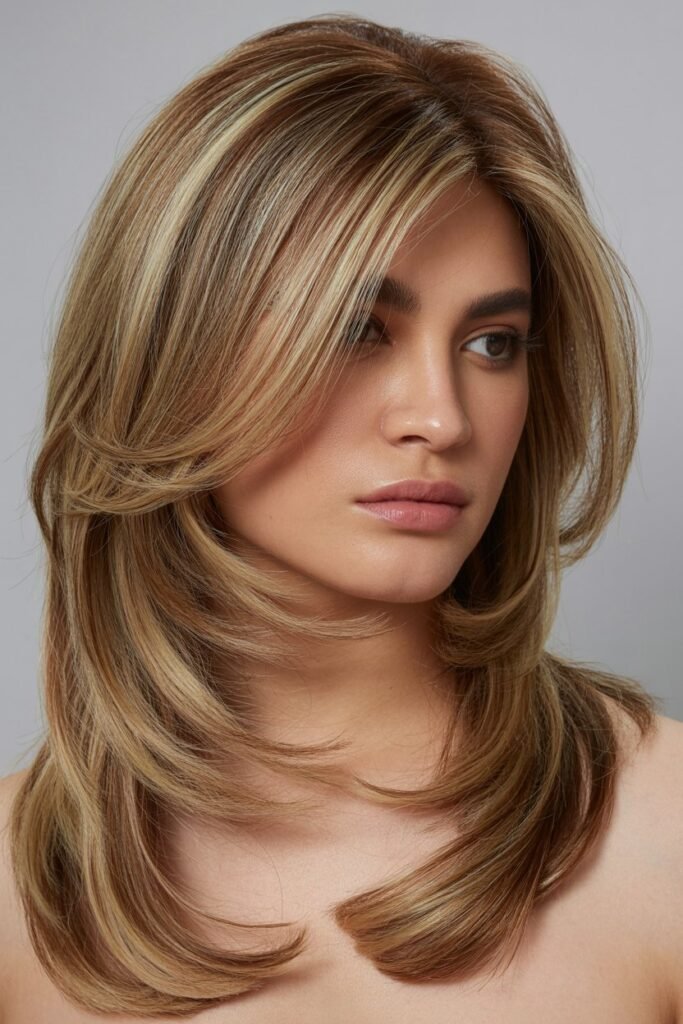
The butterfly cut uses visible face-framing layers around the cheekbones and crown to create lift and body, then keeps the length long below. For a round face, ask for the shortest face-framing layer to land at the chin (NOT the cheekbone), with the rest of the layers cascading from there. The lift at the crown is what makes this flattering — it adds height, which elongates the face.
8. Subtle butterfly cut
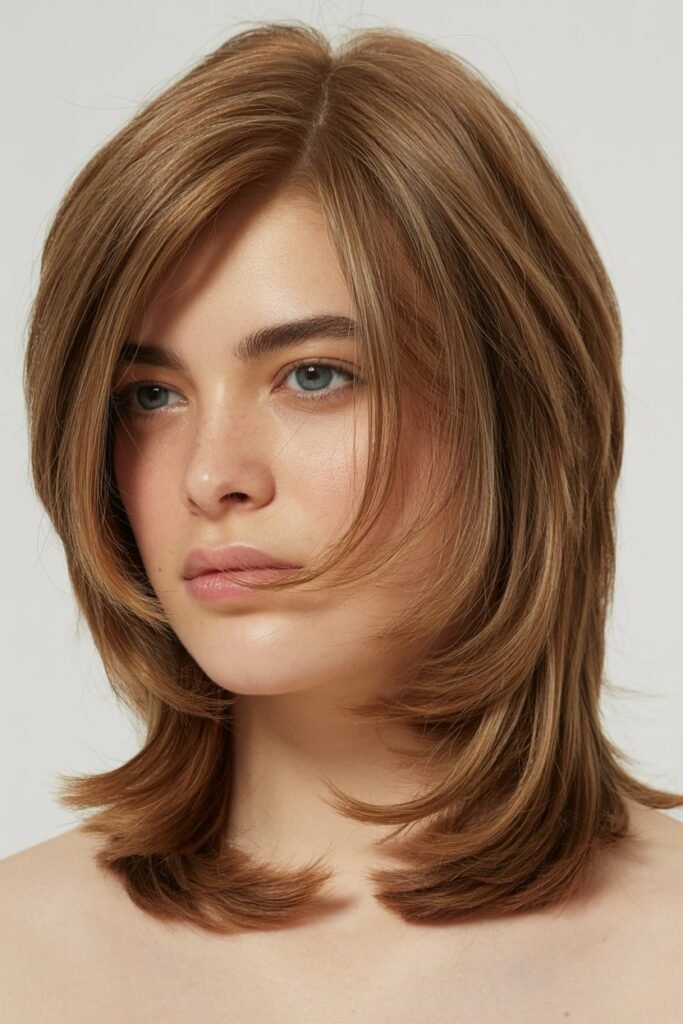
A toned-down version of the butterfly. Less dramatic layering, but still featuring visible face-framing and crown lift. Best for people who want the butterfly effect but a more low-maintenance, less “obviously layered” finish.
9. Long bombshell shag
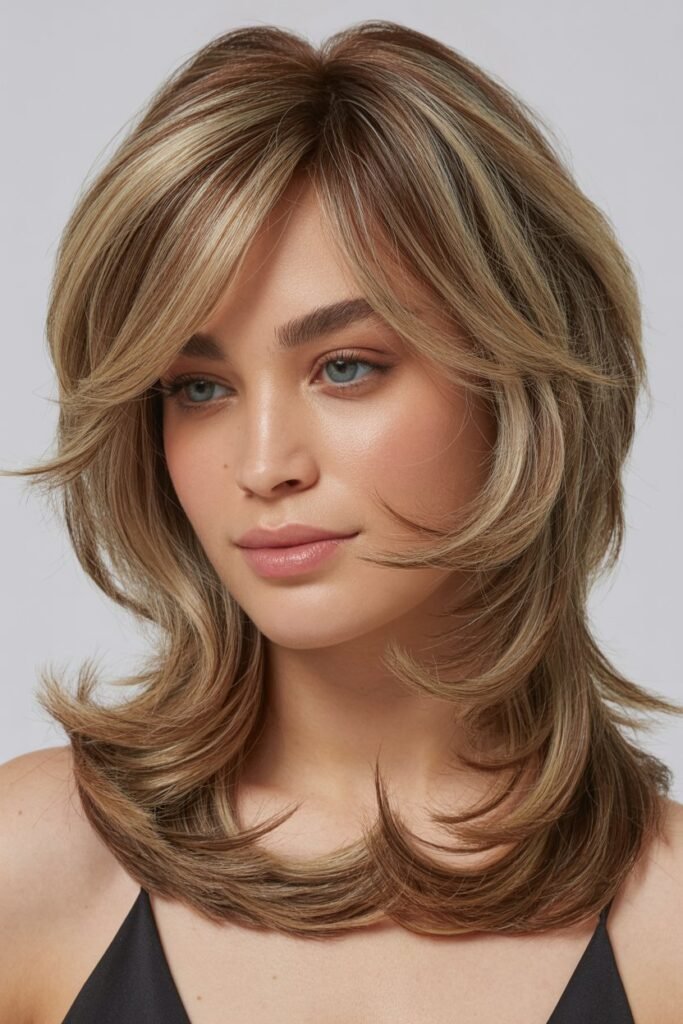
The 2026 shag has soft volume and romantic movement. Shorter layers in the crown create fullness, gradually tapering into the length with curtain bangs and cheekbone-framing pieces. For round faces, specifically request “long bombshell shag with face frame starting at the chin” — that single instruction prevents the most common shag mistake on round faces (layers that widen the cheeks).
10. Long wolf cut
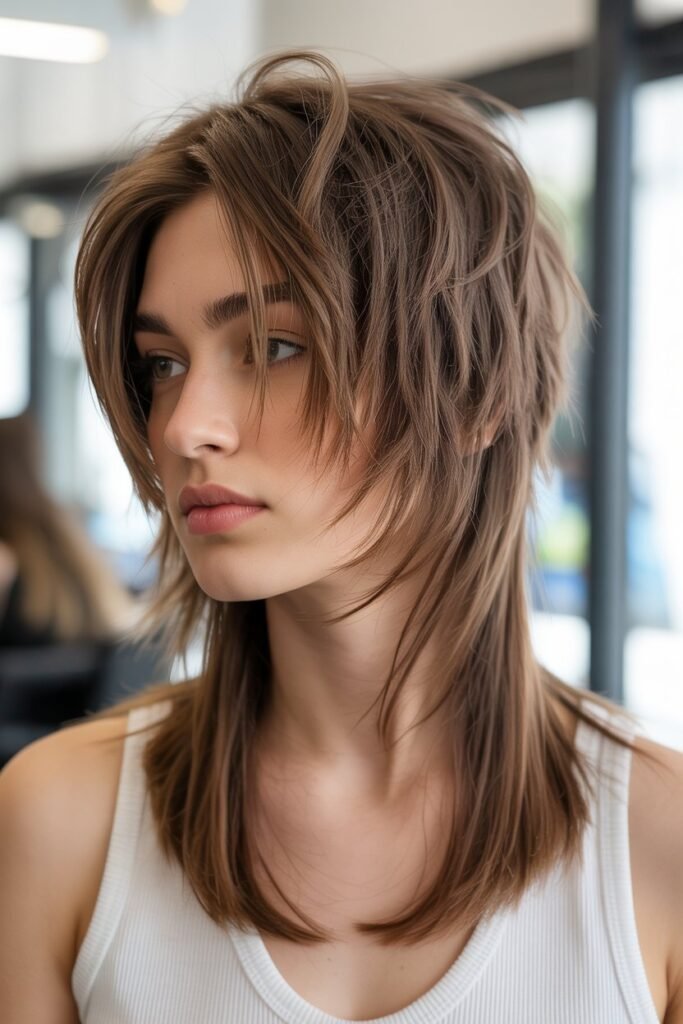
The wolf cut is a hybrid of shag and mullet — shorter, choppy layers in the crown and longer layers below. On a round face, keep the shortest crown layers around the ear level (NOT shorter), and let everything below the chin stay long. The contrast between the textured crown and the long smooth ends adds vertical visual movement.
11. Modern ’70s-inspired long shag
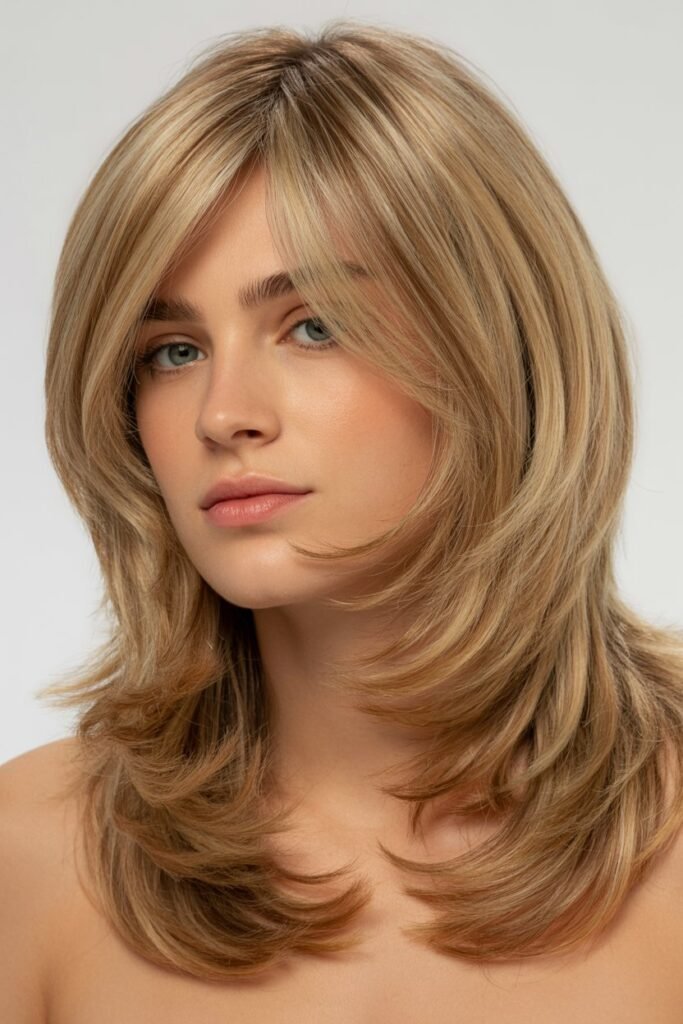
A longer, less choppy version of the bombshell shag. Inspired by 1970s Farrah Fawcett wings, but updated with softer, less symmetrical layering. The natural movement of the cut draws the eye downward, which elongates a round face.
V-cut and U-cut long layers
A V-cut or U-cut refers to the shape of the back of the hair when it’s down. Both shapes create a strong vertical line that visually slims and lengthens a round face.
12. Long V-cut layers
The back of the hair comes to a point in the middle, creating a strong V-shape. This is one of the most slimming cuts for a round face because it draws the eye downward to a point, elongating the visual line of the face and hair together. Best on straight-to-wavy hair where the V-shape is most visible.
13. Soft U-cut long layers
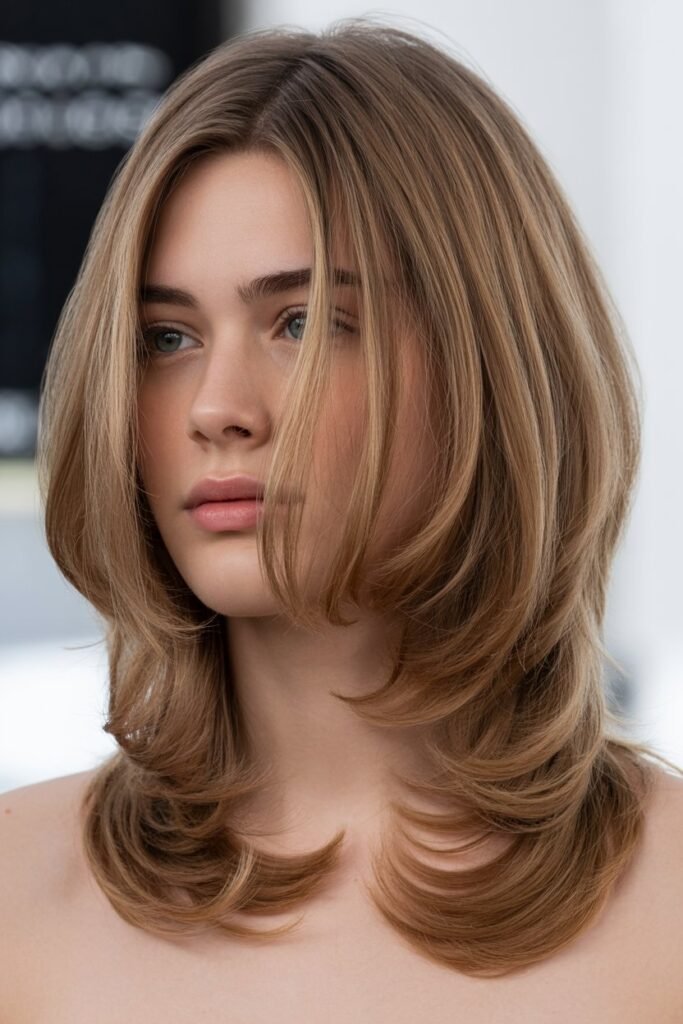
A softer version of the V-cut — the back rounds into a U-shape rather than coming to a point. Less dramatic, still flattering. Best for people who want a soft, feminine silhouette rather than a sharp graphic one.
14. V-cut with face-framing layers
V-cut at the back, plus layers at the front that frame the face starting at the chin. This combination addresses both the back silhouette AND the front of the face — twice the slimming effect.
15. V-cut with curtain bangs
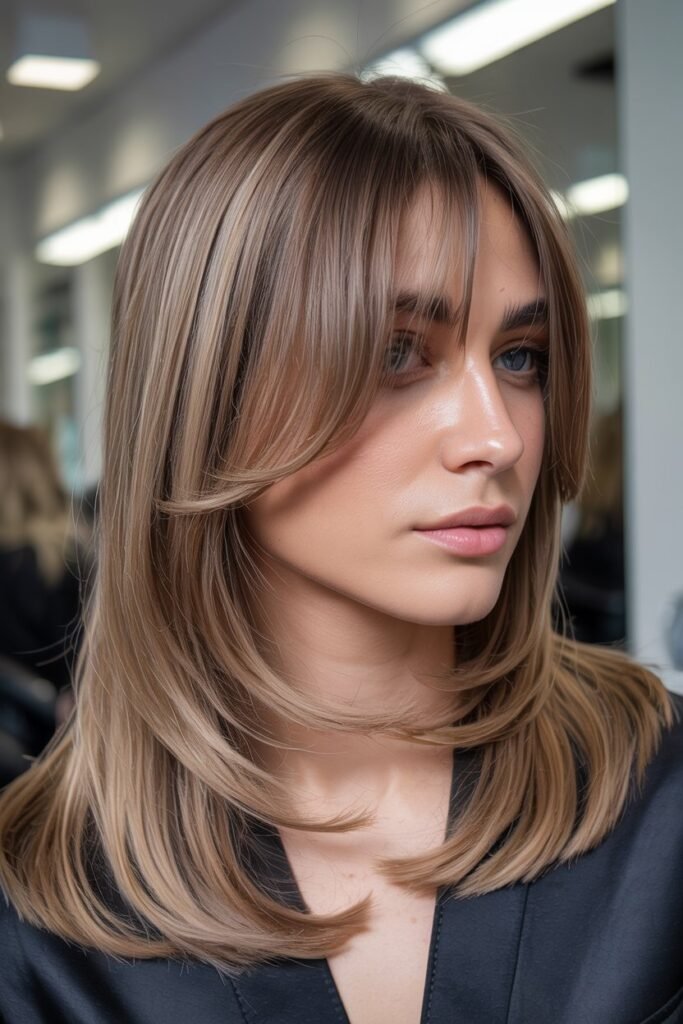
V-cut at the back, curtain bangs at the front. The most elongating combination on this list. The vertical line of the curtain bangs in front + the vertical point of the V-cut in back creates two distinct slimming visual lines. If you have a noticeably round face and want maximum impact, ask for this combination.
Face-framing layered cuts
Face-framing layers are the front sections of hair cut shorter than the rest, designed to frame the face like a portrait. On a round face, where these layers start determines whether they flatter or widen.
16. Long layers with chin-length face frame
Face-framing layers that start at the chin level. The chin is the safest starting point for round faces — it puts the layers at the edge of the face without adding width to the cheek area. The hair drapes past the cheek and frames the chin, which has a slimming effect.
17. Long layers with collarbone face frame
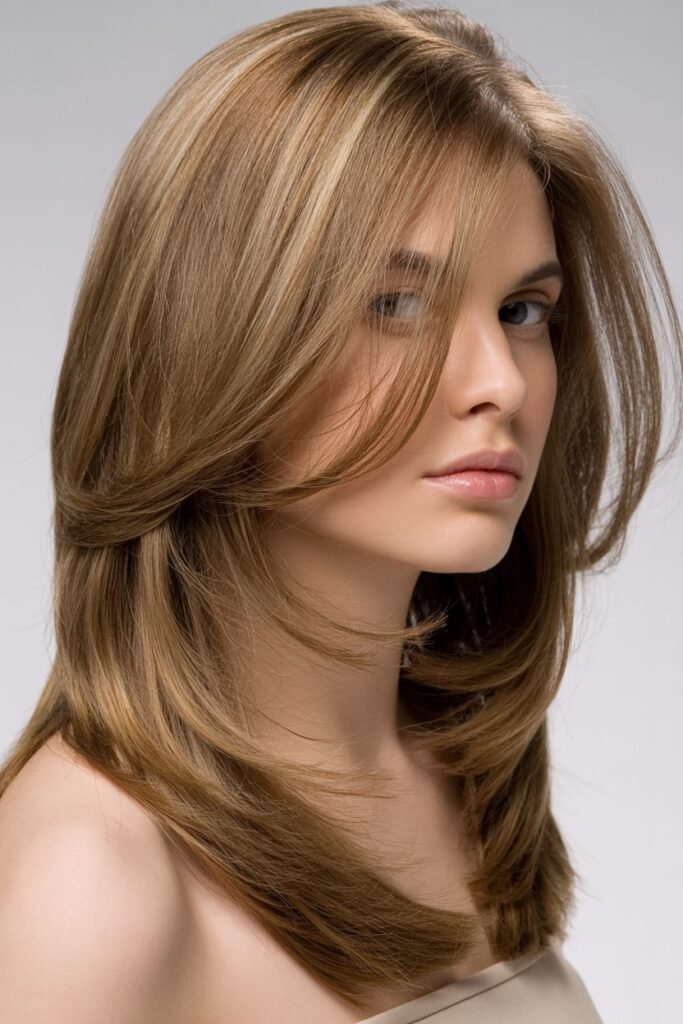
Face-framing layers that start even lower — at the collarbone — for maximum elongation. Best for very round faces or anyone who wants the most subtle, dramatic length-creating effect.
18. Long layers with side-swept face frame
Face-framing layers cut at an angle, designed to sweep diagonally across one side of the face. The asymmetric line is hugely flattering — it creates angular definition that softer, even layers don’t.
19. Money piece with long layers
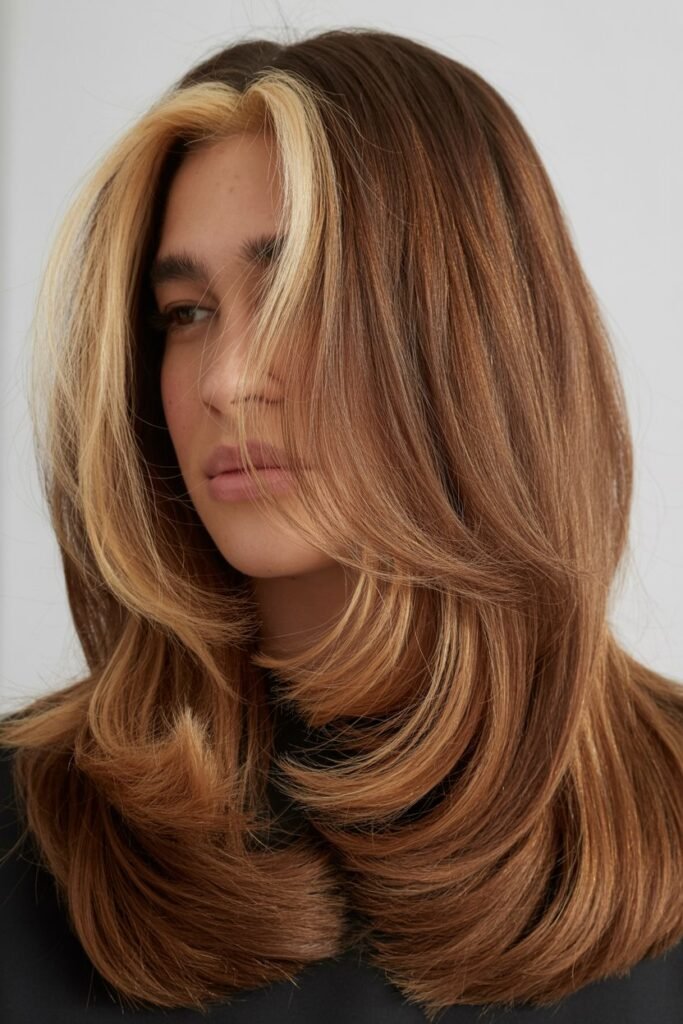
Long layers with a “money piece” — two lighter-colored sections of hair framing the face. The color contrast draws the eye to the center of the face, away from the cheek width. Works especially well in honey blonde, caramel, or copper tones on darker base hair.
20. Layered ends with face frame
The face-framing is subtle (starts below the chin) but the ends of the hair are heavily layered for movement and texture. This gives you the flattering effect of long layers without an obvious “layered haircut” look. Best for people who want a low-maintenance, natural finish.
Layered cuts for round faces with specific hair types
The same cut behaves differently on different hair textures. These three styles address common combinations.
21. Long layers for round face + thin hair
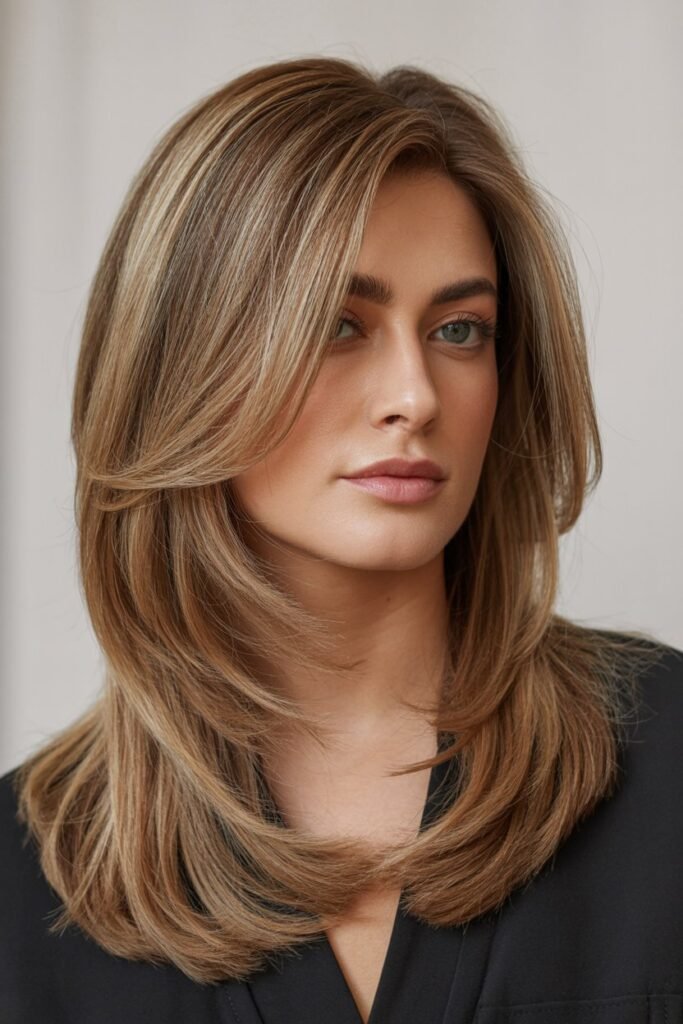
Subtle, “invisible” internal layering combined with face-framing layers starting at the chin. Heavy layering thins out fine hair further, but no layering at all leaves it looking flat and adds visual width to the face. The sweet spot is light internal layering for movement, plus face-framing for shape.
22. Long layers for round face + thick hair
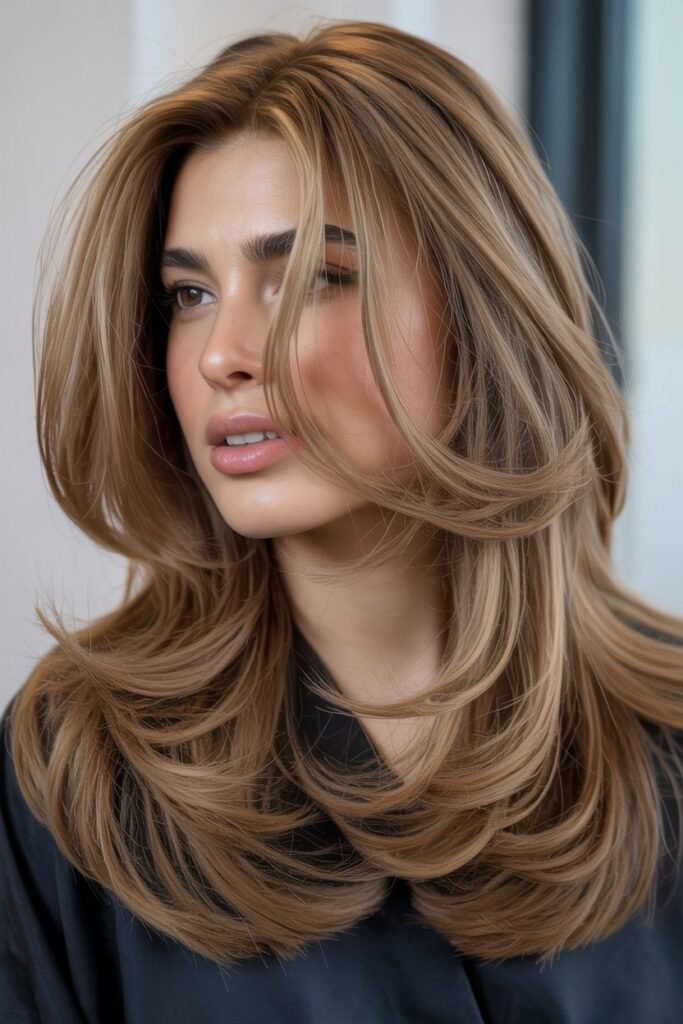
For thick hair on a round face, the goal is to remove weight without removing length. Ask for “internal debulking” — invisible layers within the hair that lighten it from the inside, plus face-framing layers starting at the chin. Avoid heavy blunt bottoms (they bulk up at the cheek and chin area).
23. Long layers for round face + curly or wavy hair
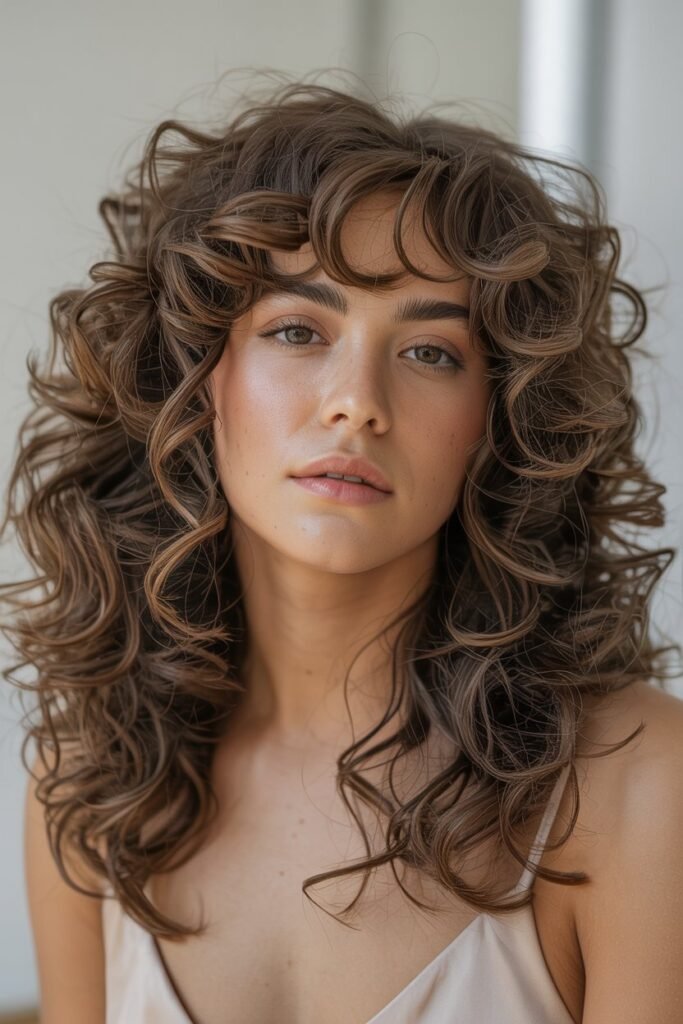
For curly hair on a round face, the worst thing you can do is layer at the cheekbone level (the curls will spring up and widen the face dramatically). The right cut: long layers starting at the chest level, with face-framing pieces that fall past the curl spring-back point. When wet, the layers should look almost too long — they’ll spring up to flattering when dry.
What to tell your stylist
Bring this post (or your saved Pinterest pins) to the appointment. Then say these specific things:
Always say:
- “Long layers, with face-framing that starts at the chin or below — never higher than the chin.”
- “I want vertical movement, not width at the cheekbones.”
- “If we’re doing bangs, I want curtain or side-swept — no straight-across.”
Always ask:
- “Where will the shortest face-framing layer fall when it’s dry?”
- “Will the layers add volume at the crown or at the sides?” (You want crown.)
- “Can we point-cut the ends instead of blunt-cutting?” (Point-cutting creates softer ends that don’t add visual width.)
Always avoid:
- Layers that start at the cheekbone
- Heavy blunt bottoms
- Straight-across bangs at the eyebrow line
- A “one-length” bob or lob — these always read wider on round faces
- Hair tucked behind both ears at the cheek (creates a circle around the face)
If your stylist suggests something different than what you’ve shown them, ask them to explain why and how it’ll flatter a round face specifically. A good stylist can walk you through their reasoning. A stylist who can’t is the wrong stylist for this cut.
How to style long layers to flatter a round face
The cut is only half the battle. How you style it determines whether you wake up with a round-face-friendly look or one that fights you.
Volume at the crown. Lift hair at the roots when you blow-dry — section by section, lifting upward with a round brush. Volume at the top of the head adds height, which elongates the face vertically. Avoid volume at the sides.
Smooth at the cheek line. Where the hair passes over your cheekbones, smooth it down rather than letting it puff out. A small amount of smoothing serum applied to that section only does the trick. Curly and wavy hair: define this section with leave-in cream so the curls hang straight down rather than springing out.
Curl away from the face, never toward it. When you use a curling iron or wand on the front sections, always curl the hair away from your face. Curls that wrap toward the cheek visually add width; curls that flow away from the cheek elongate.
Side part > center part for some round faces. A deep side part creates an asymmetric line across the forehead, which adds angular definition to a soft face shape. Center parts can work, but only if the curtain bangs or face-framing layers are doing the elongating work for you. Test both, photograph yourself, and compare.
Air-dry tip for curly/wavy hair: when you scrunch in product, scrunch upward (from ends toward roots) rather than down. This creates lift and volume at the crown rather than springing curls outward at the cheek.
Frequently asked questions
What length of layered hair is best for a round face?
Mid-back to waist length is ideal. Anything significantly above the shoulder tends to add width to a round face rather than length. If you want shorter hair, the lob (long bob) ending at the collarbone is the shortest length that still flatters a round face — but the cut needs to be done carefully, with face-framing starting below the chin.
Should I get bangs if I have a round face?
Yes — but only the right kind. Curtain bangs, side-swept bangs, and wispy long fringe all work beautifully on round faces because they create vertical or diagonal lines. Straight-across blunt bangs at the eyebrow line shorten the face visually and usually make a round face look rounder. If you love the “fringe” look, go for a long, wispy curtain version rather than a blunt one.
Will long layers make my round face look thinner?
Layers themselves don’t make your face physically thinner — but the right cut creates a visual illusion that elongates and slims. The combination of vertical lines (long length, V or U cuts, curtain bangs) and movement that draws the eye downward all contribute to a slimmer-looking face. Most people see a noticeable difference between a one-length blunt cut and a layered cut on the same round face.
How often should I trim long layers for a round face?
Every 8–12 weeks to keep the shape. Layered cuts grow out into one-length cuts if you wait too long, and a one-length cut on a round face is exactly what you’re trying to avoid. If your hair grows slowly, you can stretch to 14 weeks — but no longer, or you’ll lose the flattering shape.
Can I get layers if my hair is very fine?
Yes, with the right approach. Heavy or aggressive layering will thin out fine hair and leave it looking sparse. Instead, ask for very subtle “invisible” internal layers (just enough for movement) plus face-framing layers starting at the chin. The face-framing does most of the flattering work; the internal layers just add a touch of movement without sacrificing density.
What’s the difference between a butterfly cut and a long shag for round faces?
Both feature visible face-framing layers and crown volume. The butterfly cut tends to be smoother, more polished, and more bouncy — designed for blowouts and round-brush styling. The shag is more textured, choppier, more “rock and roll.” Both flatter round faces when cut correctly. Pick the butterfly if you prefer a polished finish; pick the shag if you prefer effortless texture.
I have a round face AND a double chin — does this change the recommendations?
The same rules apply, just emphasized further. Keep face-framing layers at the chin or below (collarbone level can be even more flattering). Avoid hair tucked behind the ears at the chin — it draws attention to the area. Long hair worn down past the chin acts like a curtain that visually slims the lower face. V-cuts and curtain bangs are especially flattering.


![4 Best Locking Gel for Dreads [Ultimate Guide]](https://magicalassam.com/review/wp-content/uploads/2022/06/Best-Locking-Gel-for-Dreads.jpg)