
“Glowy skin” used to mean expensive facials and inherited genetics. In 2026, it means a smart routine — the right ingredients, in the right order, used consistently. And honestly, most of the work is just showing up every day.
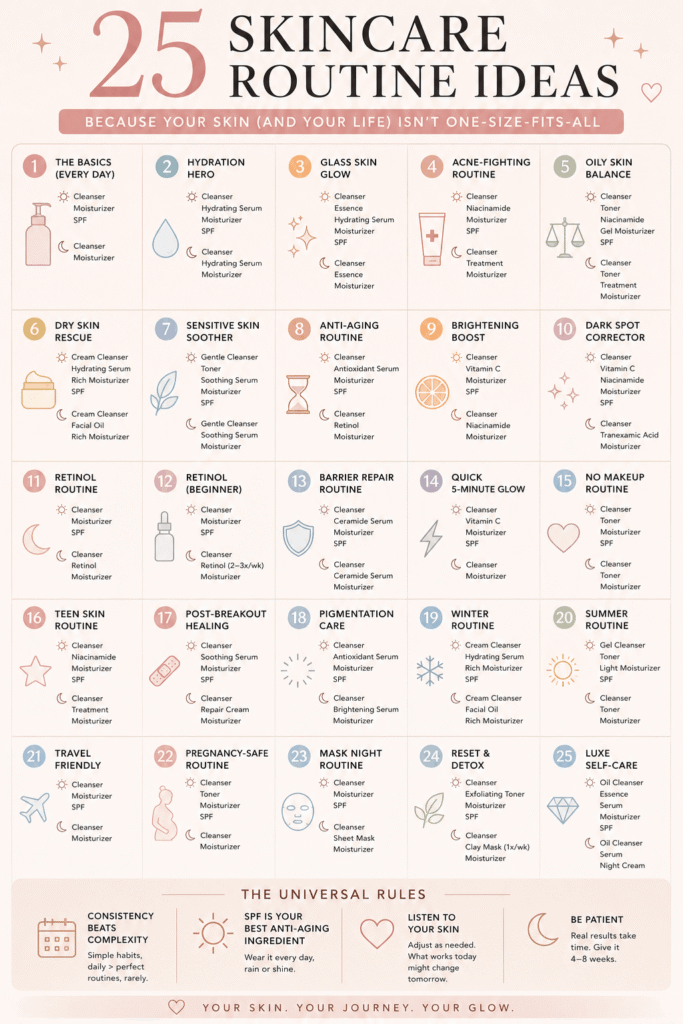
This post is the complete guide to 25 skincare routine ideas for glowy skin — covering morning routines, night routines, routines for every skin type (oily, dry, combination, sensitive, mature, acne-prone), the trending 2026 ingredients you should know, and the products worth the splurge versus the ones you can drugstore.
You’ll get realistic routines (not the 14-step Korean beauty ones nobody actually does) plus the underrated tricks that take skin from fine to glowing without adding hours to your morning.
📌 Quick navigation: skip to your skin type, jump to the ingredient guide, or save this post for your next Sephora order.
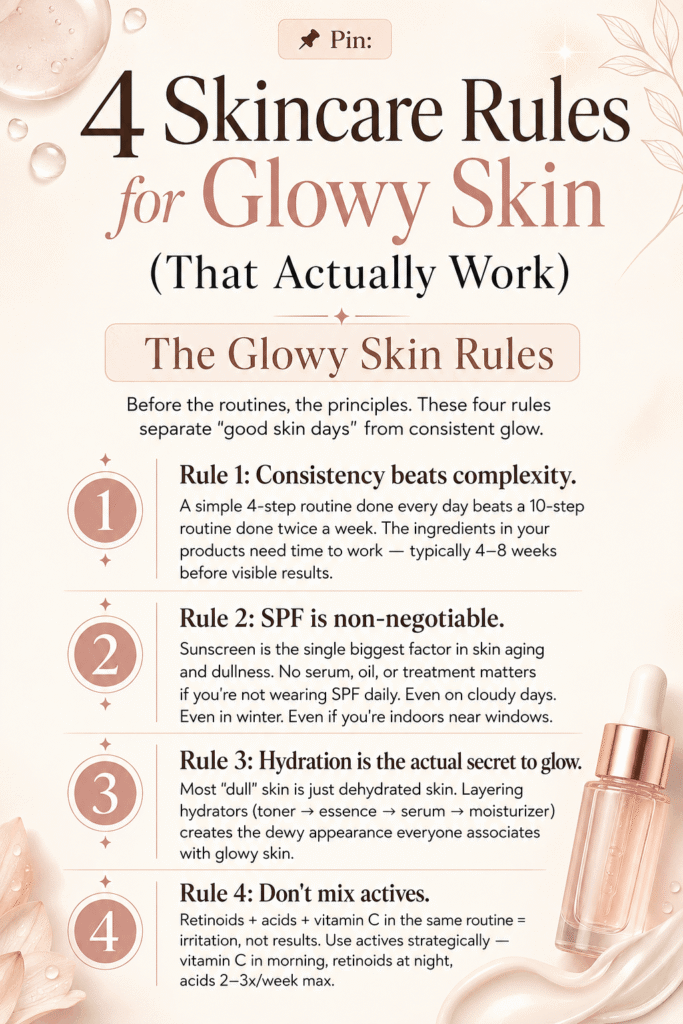
The Glowy Skin Rules
Before the routines, the principles. These four rules separate “good skin days” from consistent glow.
Rule 1: Consistency beats complexity. A simple 4-step routine done every day beats a 10-step routine done twice a week. The ingredients in your products need time to work — typically 4–8 weeks before visible results.
Rule 2: SPF is non-negotiable. Sunscreen is the single biggest factor in skin aging and dullness. No serum, oil, or treatment matters if you’re not wearing SPF daily. Even on cloudy days. Even in winter. Even if you’re indoors near windows.
Rule 3: Hydration is the actual secret to glow. Most “dull” skin is just dehydrated skin. Layering hydrators (toner → essence → serum → moisturizer) creates the dewy appearance everyone associates with glowy skin.
Rule 4: Don’t mix actives. Retinoids + acids + vitamin C in the same routine = irritation, not results. Use actives strategically — vitamin C in morning, retinoids at night, acids 2–3x/week max.
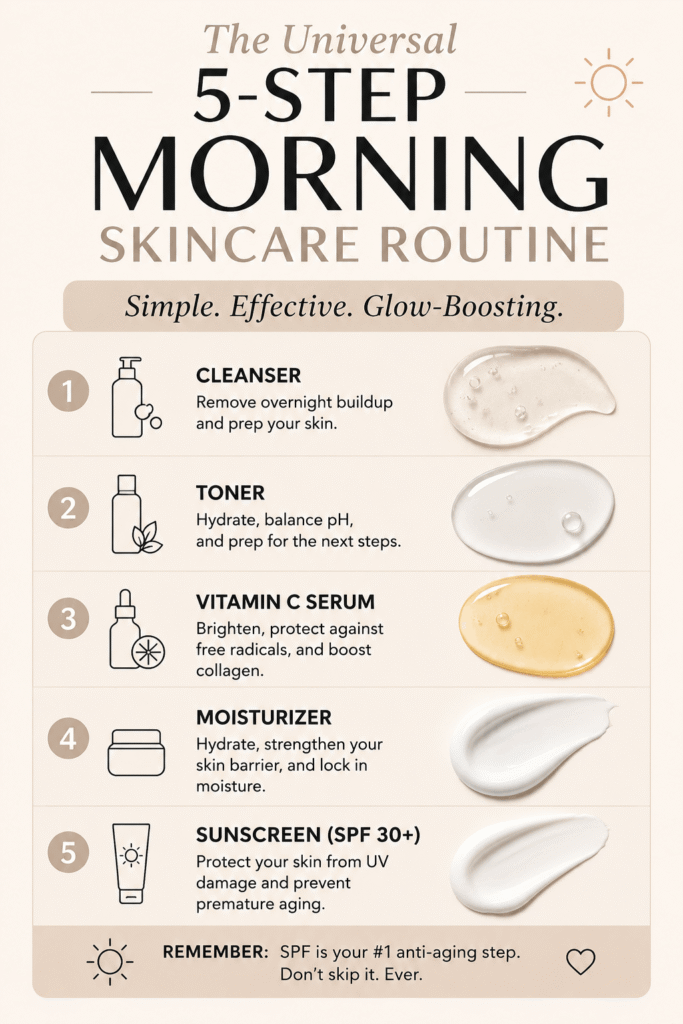
The Universal Morning Routine (1–5)
This is the foundation. Five steps, 5 minutes total. Suitable for nearly every skin type.
1. Gentle Cleanser
A gentle, non-stripping cleanser to remove overnight oil and product buildup. Skip foaming cleansers in the morning — they strip too much.
Best for: All skin types.
Why it works: Sets a clean slate without disrupting your skin barrier.
Quick tip: Cream and gel cleansers are gentler than foam. Rinse with lukewarm water — never hot.
2. Vitamin C Serum
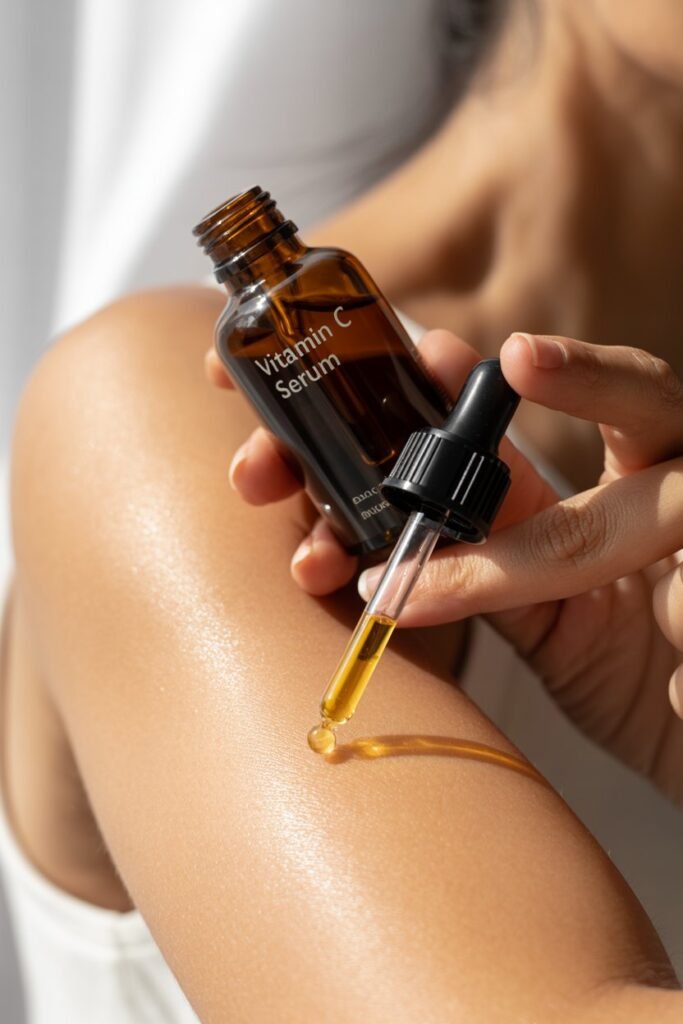
A vitamin C serum (10–20% L-ascorbic acid or stable derivatives like SAP) for brightness and antioxidant protection.
Best for: Dullness, uneven tone, anti-aging.
Why it works: Vitamin C neutralizes free radicals from sun and pollution AND brightens over time.
Quick tip: Store vitamin C in a cool dark place — light and heat destroy it.
3. Hydrating Toner or Essence
A hydrating (not astringent) toner with hyaluronic acid, glycerin, or beta-glucan. Press it into damp skin with hands.
Best for: All skin types, especially dehydrated.
Why it works: Adds the first layer of hydration that everything else builds on.
Quick tip: Apply to damp skin, not dry — hyaluronic acid works best when there’s moisture to pull in.
4. Lightweight Moisturizer
A gel or lotion-style moisturizer (heavier creams reserved for night). Should sit comfortably under makeup.
Best for: All skin types.
Why it works: Locks in hydration from previous steps and creates a smooth base for SPF.
Quick tip: Apply while skin is still slightly damp from toner.
5. SPF 30+ Sunscreen
The most important step. Mineral or chemical, whatever you’ll actually use. Reapply every 2 hours if outside.
Best for: Everyone, every day, no exceptions.
Why it works: Prevents 90% of visible skin aging, dullness, and dark spots.
Quick tip: Use 2 fingers’ worth for face + neck. Most people apply 1/4 the recommended amount.
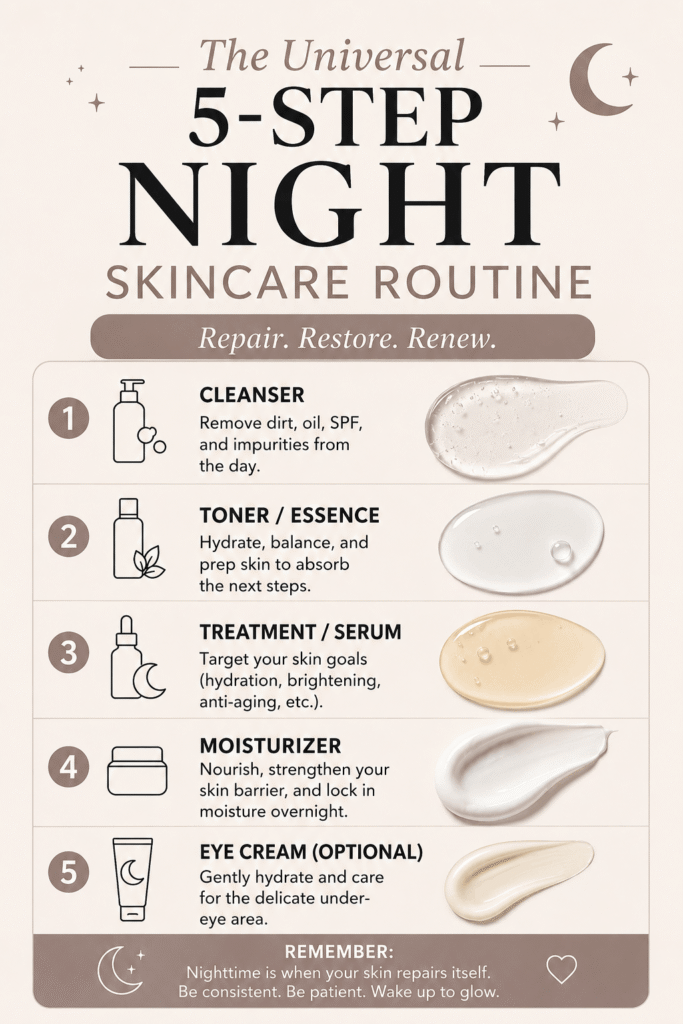
The Universal Night Routine (6–10)
Night is when your skin actually rebuilds. These five steps make the most of the repair window.
6. Oil-Based Cleanser (Double Cleanse Step 1)
If you wear makeup or SPF, start with an oil cleanser to dissolve everything. Massage onto dry skin, then add water to emulsify.
Best for: Anyone wearing makeup, sunscreen, or living in a polluted city.
Why it works: Water-based cleansers can’t remove oil-based products effectively.
Quick tip: Skip if you’re not wearing makeup or heavy SPF — single cleanse is enough.
7. Gentle Cream Cleanser (Double Cleanse Step 2)
The second cleanse to remove anything the oil cleanser left behind. Use the same morning cleanser.
Best for: All skin types.
Why it works: Removes water-soluble residue.
Quick tip: Total cleansing time should be 30–60 seconds, not a 3-minute deep scrub.
8. Treatment Serum (Retinoid OR Acid, Not Both)
The active ingredient that does the heavy lifting. Retinoid for anti-aging and acne; AHA/BHA for exfoliation and texture; niacinamide for pores and redness.
Best for: Targeted concerns (lines, acne, texture, pigmentation).
Why it works: This is where visible results come from.
Quick tip: Start with one active. Add a second only after 6+ weeks of tolerance.
9. Rich Moisturizer or Cream
Heavier night cream that wouldn’t work under makeup. Look for ceramides, peptides, or squalane.
Best for: All skin types (oily skin can use lightweight gel-creams).
Why it works: Skin’s repair process runs overnight; rich moisturizer supports it.
Quick tip: Apply within 60 seconds of toner/essence to lock in moisture.
10. Face Oil (Optional but Glow-Boosting)
Apply 2–3 drops of face oil OVER moisturizer (not under). Squalane, rosehip, and marula are the most universally tolerated.
Best for: Dry, dehydrated, mature, or dull skin.
Why it works: Seals everything in and provides instant glow.
Quick tip: Warm 3 drops in your palms first, then press into skin.
Routines by Skin Type (11–18)
The universal routines work for most people, but these tweaks optimize for specific skin types.
11. Routine for Oily Skin
- Morning: Foaming cleanser → niacinamide serum → lightweight gel moisturizer → mattifying SPF
- Night: Double cleanse → BHA (salicylic acid) 2–3x/week → oil-free moisturizer
Key ingredients: Niacinamide, salicylic acid, zinc, retinoids.
Avoid: Heavy creams, comedogenic oils (coconut, almond), occlusive products.
Quick tip: “Oily” doesn’t mean “doesn’t need moisturizer” — stripped skin produces more oil.
12. Routine for Dry Skin
- Morning: Cream cleanser → hydrating essence → vitamin C → rich moisturizer → SPF + 2 drops oil
- Night: Cream cleanser → hyaluronic acid serum → ceramide cream → face oil seal
Key ingredients: Hyaluronic acid, ceramides, squalane, peptides, fatty acids.
Avoid: Foaming cleansers, drying alcohols, harsh exfoliants.
Quick tip: Layer hydrators on damp skin — the trick is in the timing.
13. Routine for Combination Skin
- Morning: Gentle gel cleanser → niacinamide → lightweight moisturizer (or 2 different ones for T-zone vs cheeks) → SPF
- Night: Double cleanse → alternating BHA and retinoid → hyaluronic serum → balanced moisturizer
Key ingredients: Niacinamide, hyaluronic acid, BHA (for T-zone), peptides.
Avoid: One-size-fits-all approaches — combination skin needs zone-specific care.
Quick tip: Apply richer products to dry cheeks, lighter products to oily T-zone.
14. Routine for Sensitive Skin
- Morning: Gentle non-foaming cleanser → centella asiatica serum → fragrance-free moisturizer → mineral SPF
- Night: Cream cleanser → niacinamide → ceramide cream
Key ingredients: Centella asiatica (Cica), niacinamide, ceramides, oat extract.
Avoid: Fragrance, essential oils, alcohol, harsh exfoliants, retinoids (initially).
Quick tip: Introduce ONE new product at a time. Patch test on your inner arm for 3 days first.
15. Routine for Acne-Prone Skin
- Morning: BHA cleanser → niacinamide → light moisturizer → mineral SPF
- Night: Double cleanse → adapalene (retinoid) OR salicylic acid (not both same night) → oil-free moisturizer
Key ingredients: Salicylic acid, niacinamide, adapalene, azelaic acid, benzoyl peroxide (spot treat).
Avoid: Picking, comedogenic oils, over-exfoliating, skipping moisturizer.
Quick tip: Don’t pile on multiple acne actives — pick one and use consistently.
16. Routine for Mature Skin (40+)
- Morning: Cream cleanser → vitamin C serum → peptide serum → ceramide moisturizer → SPF
- Night: Double cleanse → retinoid (or retinol) → peptide cream → face oil
Key ingredients: Retinoids, peptides, vitamin C, ceramides, niacinamide, hyaluronic acid.
Avoid: Over-exfoliating, harsh actives, drying products.
Quick tip: Layer hydrators (essence → serum → cream) for the plumping effect.
17. Routine for Hyperpigmentation
- Morning: Gentle cleanser → vitamin C → niacinamide → SPF (chemical for higher protection)
- Night: Double cleanse → alpha arbutin OR tranexamic acid → moisturizer → SPF the next day
Key ingredients: Vitamin C, alpha arbutin, tranexamic acid, niacinamide, kojic acid.
Avoid: Skipping SPF (dark spots will return immediately).
Quick tip: Results take 8–12 weeks. Document with photos.
18. Routine for Eczema-Prone Skin
- Morning: Gentle wash → ceramide moisturizer → mineral SPF
- Night: Cream cleanser → colloidal oatmeal serum → barrier-repair cream
Key ingredients: Ceramides, colloidal oatmeal, niacinamide, squalane.
Avoid: Fragrance, sulfates, essential oils, retinoids (during flares).
Quick tip: During flares, simplify to 3 products only — wash, treat, moisturize.
2026’s Trending Skincare Ingredients (19–22)
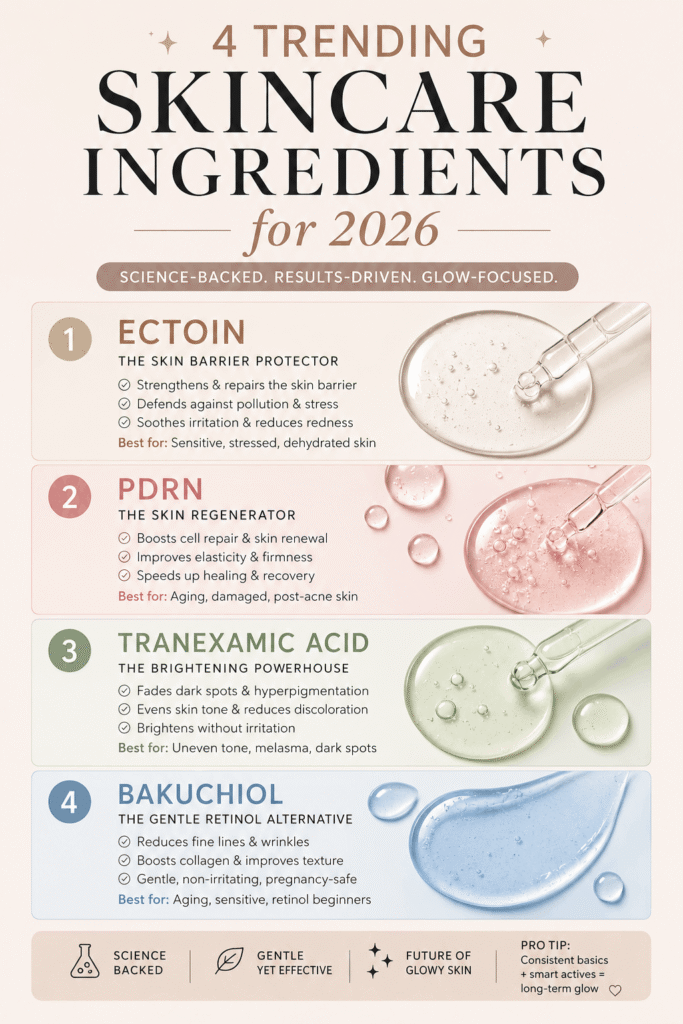
These four ingredients are dominating Pinterest, TikTok, and beauty industry coverage in 2026. Worth knowing about.
19. Polyglutamic Acid (PGA)
The “next hyaluronic acid.” Holds 4x more water than HA and creates a moisture-locking film on skin. Massive 2026 trending ingredient.
Best for: Dehydrated, mature, dull skin.
Why it works: Plumping effect is immediate AND long-lasting.
Quick tip: Layer PGA after hyaluronic acid for maximum hydration stack.
20. Bakuchiol
The plant-based retinol alternative. Trending hard with sensitive-skin and pregnant users who can’t use traditional retinoids.
Best for: Sensitive skin, retinoid-averse, pregnancy-safe routines.
Why it works: Provides retinoid-like results (texture, fine lines, brightness) without irritation.
Quick tip: Can be used morning AND night (unlike retinol which is night-only).
21. Snail Mucin
Korean beauty’s biggest export. Hydrating, healing, and brightening. Now mainstream in 2026 — at Sephora, Ulta, even Target.
Best for: All skin types, especially compromised or healing skin.
Why it works: Combines hydration + barrier repair + brightening in one ingredient.
Quick tip: Apply after toner, before serum — pat into skin until absorbed.
22. Beef Tallow (The Controversial One)
The most divisive 2026 trend. Animal-fat-based moisturizer popular in clean beauty circles, especially for dry/eczema-prone skin.
Best for: Very dry skin, eczema, those who tolerate animal-derived products.
Why it works: Fatty acid composition is biologically similar to human sebum.
Quick tip: Patch test extensively — texture and smell are not for everyone, and reactions vary.
The Glowy Skin Upgrade Tricks (23–25)
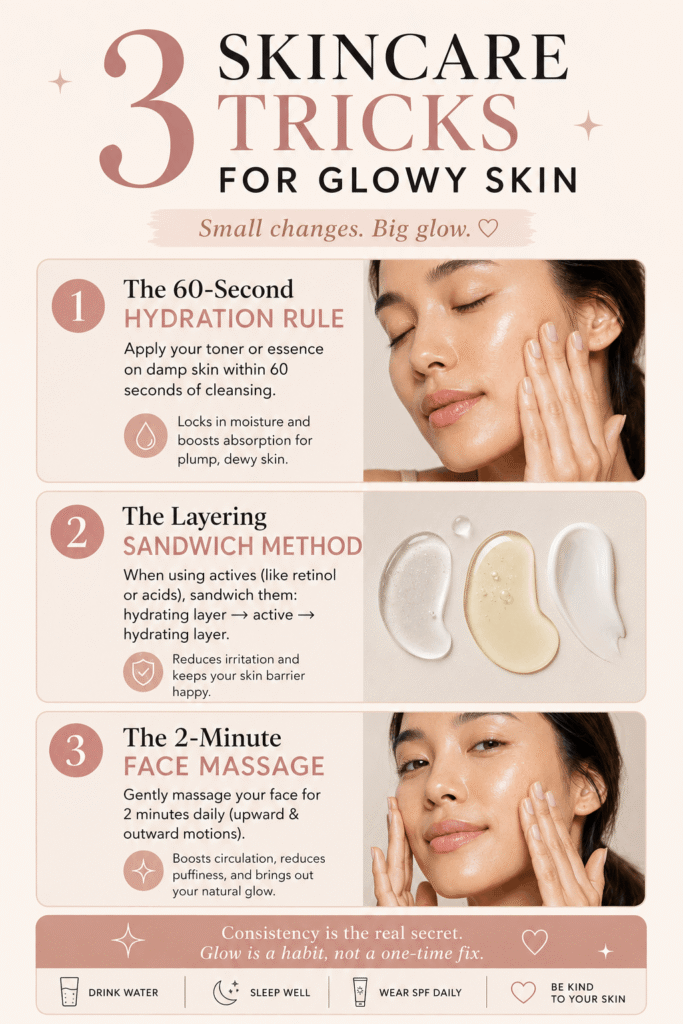
The trio of tricks that take skin from “good” to “glowing” without adding more products.
23. Face Massage with Gua Sha
5 minutes of gua sha on your moisturized face, 3x/week. Lymphatic drainage + circulation = visible glow within 2 weeks.
Best for: Dullness, puffiness, mature skin.
Why it works: Stimulates blood flow and lymphatic drainage.
Quick tip: Always use with oil or serum as glide. Direction: outward + upward.
24. Glass Skin Mist Layering
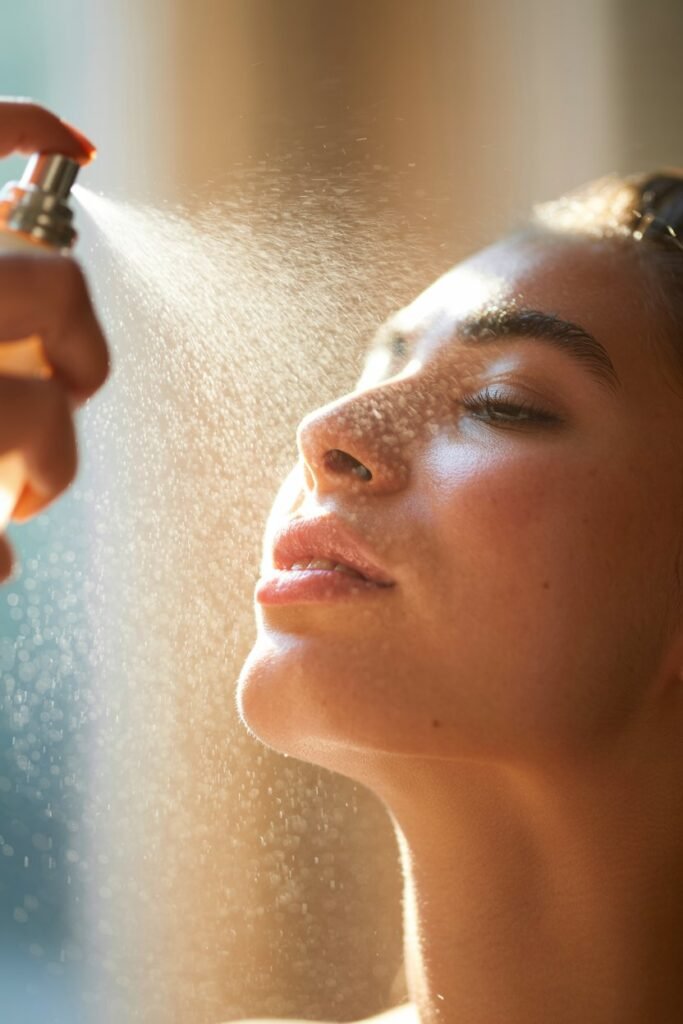
Throughout the day, mist face with hydrating mist + press in with hands. Refreshes makeup AND boosts dewy appearance.
Best for: Anyone who wants midday glow refresh.
Why it works: Reactivates the hyaluronic acid you applied in your morning routine.
Quick tip: Pick a mist with active ingredients (not just water + fragrance).
25. Strategic Highlighter Placement
A tiny dab of liquid highlighter on the high points of your face (cheekbones, brow bone, cupid’s bow) before moisturizer absorbs. Looks like genuine glow, not makeup.
Best for: Photos, events, anyone who wants instant Pinterest skin.
Why it works: Mimics natural light reflection.
Quick tip: Use a tiny amount. Less is exponentially more with this trick.
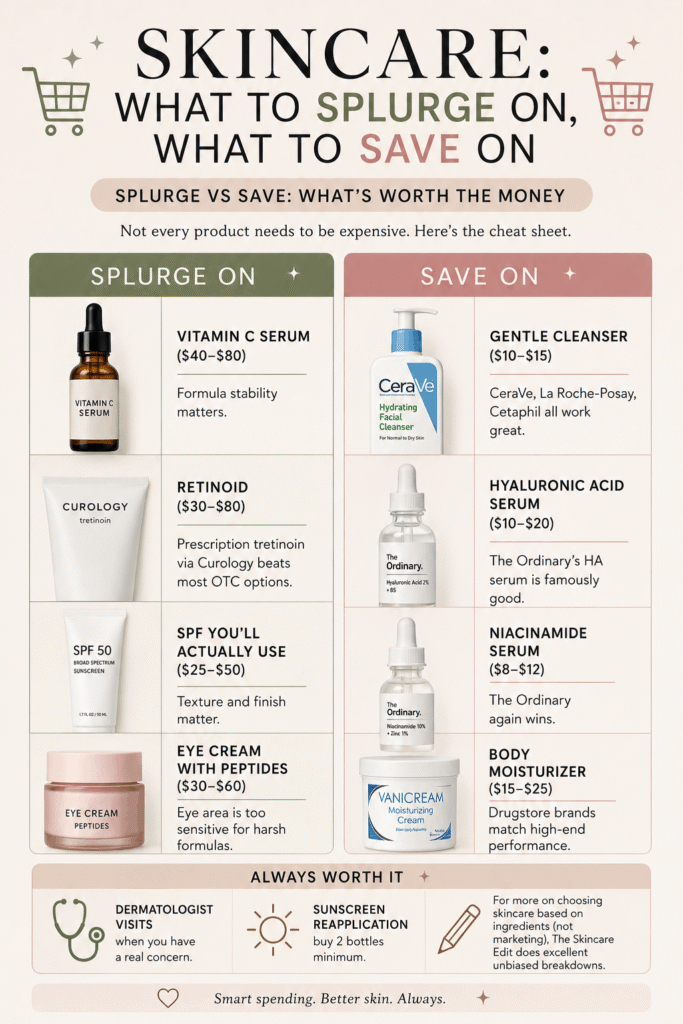
Splurge vs Save: What’s Worth the Money
Not every product needs to be expensive. Here’s the cheat sheet.
Splurge on:
- Vitamin C serum ($40–$80) — formula stability matters
- Retinoid ($30–$80) — prescription tretinoin via Curology beats most OTC options
- SPF you’ll actually use ($25–$50) — texture and finish matter
- Eye cream with peptides ($30–$60) — eye area is too sensitive for harsh formulas
Save on:
- Gentle cleanser ($10–$15) — CeraVe, La Roche-Posay, Cetaphil all work great
- Hyaluronic acid serum ($10–$20) — The Ordinary’s HA serum is famously good
- Niacinamide serum ($8–$12) — The Ordinary again wins
- Body moisturizer ($15–$25) — drugstore brands match high-end performance
Always worth it:
- Dermatologist visits when you have a real concern
- Sunscreen reapplication — buy 2 bottles minimum
For more on choosing skincare based on ingredients (not marketing), The Skincare Edit does excellent unbiased breakdowns.
FAQs
How long until I see results from a new skincare routine?
4–8 weeks for visible changes; 12 weeks for full results. The skin’s renewal cycle is 28 days, so anything visible faster than 4 weeks is typically hydration (real) or marketing (less real). Be patient and don’t change routines every 2 weeks — you can’t tell what’s working.
What’s the right order to apply skincare products?
Thinnest to thickest: cleanser → toner/essence → serums (water-based first) → eye cream → moisturizer → oil (if using) → SPF (morning only). Water-based products before oil-based. If you’re confused, the rule is: lighter texture goes first.
Can I use retinol and vitamin C together?
Use them at different times — vitamin C in the morning (protects against sun damage) and retinol at night (works during skin’s repair cycle). Using both together can cause irritation. Wait until skin tolerates each individually before considering combining.
Is “glowy skin” actually achievable for everyone?
Yes — for almost everyone, with the right routine. The exceptions: untreated medical conditions (rosacea, eczema flares, hormonal acne) need professional support first. For most people, “glow” comes from consistent hydration + SPF + targeted treatment + 8+ weeks of patience.
How often should I exfoliate for glowy skin?
2–3x per week max with chemical exfoliants (AHA/BHA). Daily exfoliation damages the skin barrier and causes dullness — the opposite of what you want. If you’re using a retinoid, you may not need additional exfoliation at all.
Conclusion
Glowy skin in 2026 isn’t about expensive products or 14-step routines — it’s about a simple consistent routine paired with the right ingredients for your skin type. Pick the morning + night routine that matches your skin, give it 8 weeks, and reassess.
Save this post for the next time you’re tempted to overhaul your routine based on a TikTok trend. The basics work. The basics always work.
![9 Best Face Wash for Skin Whitening [Tested and Reviewed]](https://magicalassam.com/review/wp-content/uploads/2021/06/Best-Face-Wash-for-Skin-Whitening.jpg)